A Meeting Point for Global Buyers and Practical Charging Technology
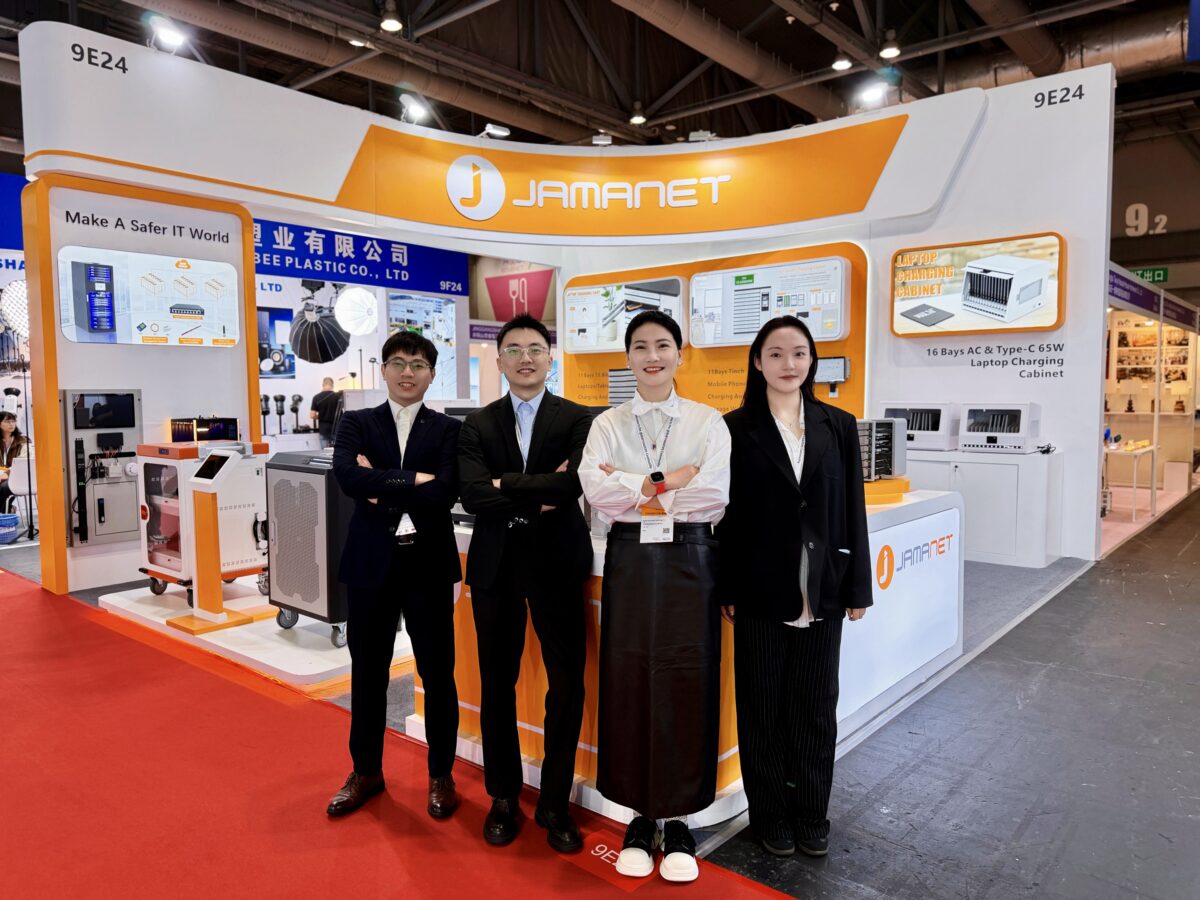
From April 11 to 14, 2026, JAMANET took part in the Global Sources Hong Kong Exhibition at AsiaWorld-Expo in Hong Kong. The event brought the brand’s smart charging portfolio to an international audience of buyers, education suppliers, corporate purchasers and system integrators. At the exhibition, JAMANET presented a connected range of products designed to help organizations charge, store and manage multiple electronic devices in a more orderly way.
The focus of the JAMANET Global Sources appearance was straightforward: organizations increasingly depend on laptops, Chromebooks, tablets and smartphones, but keeping these devices powered, secure and ready for use can be difficult when many units are deployed at the same time. JAMANET showcased solutions for different environments, from mobile device storage in classrooms to secure charging in shared public spaces and centralized charging in offices or training facilities.
Rather than treating charging as a collection of separate cables and power adapters, JAMANET’s product range brings charging, storage, cable organization and device management together. For buyers evaluating a laptop charging cart, a charging locker or a power bank charging cabinet, the exhibition offered an opportunity to discuss how product configuration can match real operational needs.
 Laptop Charging Cart: Organized Charging for Schools and Mobile Work
A laptop charging cart is a practical choice for schools, universities, training centers and businesses that move devices between rooms or use them in shared sessions. JAMANET’s laptop charging cart range is designed to store and charge multiple laptops, Chromebooks or tablets in one mobile unit. Depending on the model, capacity options can support groups of devices, helping staff prepare equipment before a class, workshop or training session begins.
Centralized storage can make daily routines easier. Instead of locating individual chargers, untangling cables and checking devices one by one, staff can return equipment to designated bays after use. Cable-management features help keep cords arranged, while a lockable cabinet helps protect devices when they are not being used. Wheels make it easier to move a charging cart between classrooms, meeting rooms or shared work areas, and visible charging indicators can help users quickly check charging status.
Charging requirements vary by device fleet. Some deployments rely on AC outlets and individual power adapters, while others may call for USB-A or USB-C charging. For buyers comparing an educational charging cart or a laptop charging cabinet, useful questions include device size, bay count, power distribution, ventilation, locking method, cable layout and the electrical standards required in the destination market. These details matter more than choosing a unit based on capacity alone.
Charging Locker: Secure Storage and Charging in Shared Spaces
A charging locker combines device charging with individual or compartment-based storage. It can be useful in offices, libraries, gyms, campuses, event venues and other places where people need a safe location to leave a phone or tablet while it charges. Compared with an open charging shelf, a charging locker gives operators a way to separate devices and manage access.
JAMANET’s charging locker solutions are designed around the practical needs of shared environments: keeping devices organized, providing a designated charging space and helping reduce the risk of devices being misplaced. Depending on the configuration, buyers can discuss different compartment layouts, lock options, charging interfaces and cabinet dimensions. For facilities managers, these choices should reflect how users access the locker, how long devices usually remain inside and whether the equipment will be supervised.
A well-specified charging locker can also simplify site operations. Separate compartments make it easier to assign a device to a user or charging position, while a suitable ventilation design helps manage heat during charging. Organizations considering a charging cabinet should review the expected device mix, maximum device dimensions, charging power, access-control requirements and maintenance arrangements before selecting a model.
Charging Kiosk: Self-Service Charging for Public-Facing Locations
In airports, shopping centers, hospitals, exhibition halls and transport hubs, visitors may need to charge a device while remaining away from a desk or private office. A charging kiosk is designed for these public-facing scenarios, where ease of use, clear instructions and an appropriate access method are important. JAMANET presented charging kiosk concepts as part of its broader smart charging solutions at the Global Sources Hong Kong Exhibition.
Depending on the project, a public charging kiosk may be configured for free charging or for a paid service model. Payment and access functions should always be confirmed for the specific configuration rather than assumed to be standard across every unit. Operators may also consider interface options, device compatibility, cabinet finish, branding and the placement of user instructions.
For buyers planning a public charging installation, the best starting point is the service model. Will users leave devices in secure compartments, or connect their own cables at an open station? Will the unit be monitored by on-site staff? Is payment required? How many users are expected during peak periods? Answers to these questions help determine whether a charging kiosk, charging locker or open power bank charging cabinet is the better fit.
Power Bank Charging Cabinet: Organized Charging and Storage for Portable Chargers
A power bank charging cabinet is designed for environments where portable chargers need to be stored, charged and managed in an organized way. It can be relevant to rental services, shopping centers, transport hubs, campuses, event venues, hotels and other public-facing locations where users may need access to a charged power bank. At the Global Sources Hong Kong Exhibition, JAMANET added the power bank charging cabinet to its smart charging product presentation.
For a power bank charging cabinet, buyers should review the number and size of compartments, charging method, access control, ventilation, cabinet footprint and how the unit will be monitored. For rental or self-service projects, it is also important to confirm whether the cabinet supports the intended battery exchange or return workflow, network functions and payment integration. These functions can vary by model and should be verified against the specific configuration.
A well-designed power bank charging cabinet helps operators keep portable chargers in a designated place and establish a more consistent charging and storage process. For venues, the cabinet may support a power-bank rental or shared-use service, depending on the selected system. Before procurement, customers should clarify user access, operating model, capacity, service and maintenance responsibilities.
One Portfolio, Different Charging Scenarios
One of the key messages from the JAMANET Global Sources presentation was that different environments need different charging formats. A mobile laptop charging cart may be ideal for a school that moves devices between classrooms. A charging locker may suit a library or office where users need secure, individual storage. A charging kiosk can serve a public venue, while a power bank charging cabinet can support organized storage and charging for portable chargers.
Choosing the correct product starts with understanding the devices and the people who use them. A school may prioritize capacity, portability, cable management and safe access. A corporate customer may focus on device security, a tidy workspace and a repeatable process for shared laptops. A public venue may place greater weight on ease of use, user access and service management. A distributor or system integrator may need multiple configurations to serve different project types.
This is why product discussions at a trade show are valuable: buyers can compare charging formats, describe their installation constraints and clarify customization needs before specifying a solution. For projects involving a laptop charging cabinet or tablet charging cabinet, it is sensible to confirm device dimensions, charging protocols, local voltage and plug requirements, lock preferences and any certification requirements early in the procurement process.
What Buyers Should Check Before Choosing a Multi-Device Charging Solution
- Device compatibility: List the device types, screen sizes, connector types and maximum dimensions that the unit must accommodate.
- Capacity and layout: Choose a bay count that reflects the current fleet and likely near-term growth, while leaving enough room for safe handling.
- Charging method and power: Confirm AC, USB-A or USB-C requirements, output per port where relevant, total power demand and local electrical standards.
- Safety and heat management: Ask about overload protection, circuit protection, ventilation and the manufacturer’s guidance for daily use.
- Security and access: Compare key locks, combination locks, electronic access or other options available for the selected model.
- Mobility and installation: Decide whether the unit needs lockable wheels, a fixed installation, wall anchoring or a compact footprint.
- Service and customization: Clarify warranty coverage, spare parts, lead time, branding options and support for project-specific configurations.
JAMANET’s Approach to Customization and Project Requirements
The Global Sources Hong Kong Exhibition also gave buyers a chance to discuss project requirements directly with the JAMANET team. A product that works well for one site may need a different bay count, lock type, charging interface or cabinet size for another. For this reason, buyers sourcing smart charging solutions should share their intended application, device list, expected quantity and destination-market requirements when requesting a quotation.
JAMANET operates in the smart charging and IT infrastructure fields, with product categories that include laptop charging carts, charging lockers, charging kiosks, power bank charging cabinets, chargers and data-center-related equipment. This combination can be relevant to customers whose projects involve end-user device charging and broader IT infrastructure planning. Final specifications, available options, certifications and delivery schedules should be confirmed with JAMANET for each order.
Continuing the Conversation After Global Sources
Trade shows create an initial connection, but a successful procurement project depends on the details that follow. After reviewing a laptop charging cart, charging locker, charging kiosk or power bank charging cabinet, buyers can prepare a short requirements brief with target capacity, device or power-bank specifications, charging method, security needs, installation environment and estimated order quantity. Providing these details helps narrow the available configurations and makes quotation discussions more productive.
For education distributors, IT integrators, office-equipment suppliers and public-space operators, the most useful solution is not necessarily the largest or most feature-heavy unit. It is the configuration that fits the users, devices and operating routine of the site. JAMANET’s participation in the 2026 Global Sources Hong Kong Exhibition highlighted its range of options for centralized device charging, secure storage and multi-device management.
Explore JAMANET Smart Charging Solutions
Whether your project calls for a mobile laptop charging cart, a secure charging locker, a public charging kiosk or a power bank charging cabinet, start by defining the devices, location and workflow. JAMANET welcomes inquiries from distributors, education suppliers, system integrators and organizations looking for practical multi-device charging solutions. Contact the JAMANET team to discuss product specifications, available configurations and the requirements of your next project.
Frequently Asked Questions
What products did JAMANET present at the 2026 Global Sources Hong Kong Exhibition?
JAMANET presented core smart charging products including laptop charging carts, charging lockers, charging kiosks and power bank charging cabinets.
Who typically uses a laptop charging cart?
Schools, universities, training centers and businesses use laptop charging carts to store, charge and move shared laptops, Chromebooks and tablets.
What is the difference between a charging locker and a power bank charging cabinet?
A charging locker emphasizes secure, compartment-based storage and charging for users’ devices. A power bank charging cabinet is designed specifically to organize and charge portable power banks, and may be part of a shared-use or rental service depending on the system.
Can JAMANET charging products be customized?
Configuration options depend on the product and project. Buyers should confirm details such as bay count, dimensions, charging interface, lock type, finish and branding directly with JAMANET.
What information should I provide when requesting a quotation?
Include device models and dimensions, required capacity, charging method, destination country, installation environment, security needs and estimated order quantity.