 As server workloads increase and rack power densities continue to rise, maintaining stable equipment inlet temperatures has become a major concern for data center operators. Cooling systems must deliver enough conditioned air to the servers while preventing hot exhaust air from returning to equipment intakes. When supply and return air mix freely, cooling capacity can be wasted and some racks may experience uneven temperatures.
Cold aisle containment is one approach to improving data center airflow management. By enclosing the aisle where server fronts draw in cool air, a cold aisle containment system creates a more controlled supply-air zone. It helps direct conditioned air toward equipment intakes and limits unwanted mixing with warmer room air. The result can be more consistent server inlet conditions and an opportunity to optimize cooling-system operation.
However, containment is not a stand-alone guarantee of energy savings. Its performance depends on the room layout, cooling architecture, rack configuration, sealing quality, airflow balance, and control strategy. This guide explains how cold aisle containment works, why it can improve cooling efficiency, and what buyers and project teams should evaluate before selecting a solution.
1. What Is Cold Aisle Containment?
In a typical hot aisle/cold aisle layout, server racks are arranged in alternating rows. The fronts of two opposing rack rows face each other to form a cold aisle, while the backs face each other to form a hot aisle. Most conventional IT equipment draws air through the front and exhausts heated air through the rear.
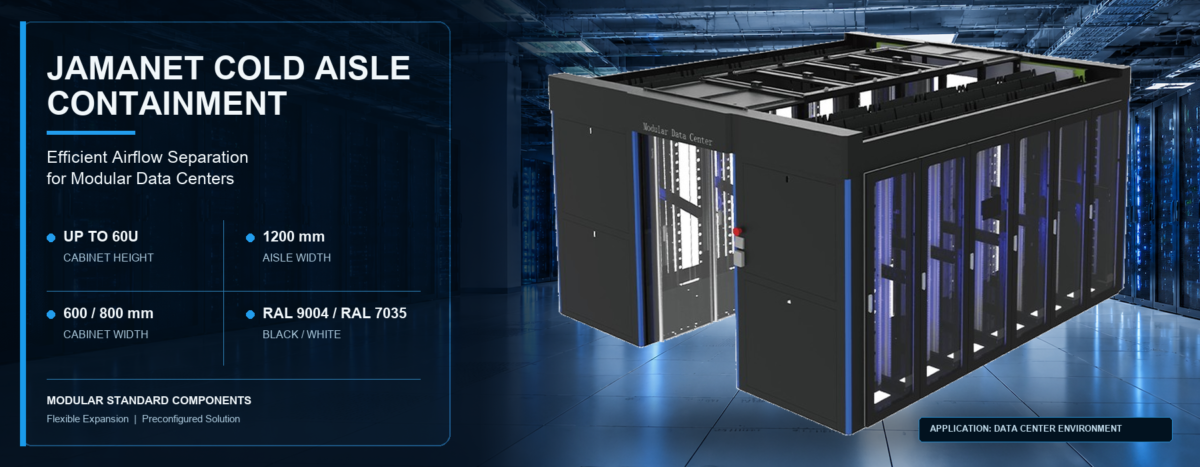
Cold aisle containment encloses the cold aisle with physical barriers. Depending on the room design, these barriers may include end-of-row doors, overhead roof panels, side panels, and interfaces that connect the enclosure to the rack rows or ceiling. The purpose is to keep the supply air in the aisle available to server intakes instead of allowing it to disperse into the surrounding room.
A cold aisle containment system may be designed as a full enclosure or a partial enclosure. A full system generally uses end doors and overhead panels to create a more complete boundary. A partial arrangement may use selected barriers or flexible elements where site conditions make a fully enclosed structure impractical. The appropriate design depends on the existing data center, cooling method, ceiling height, fire-safety requirements, and operational access needs.
Cold aisle containment should also be distinguished from hot aisle containment. Cold aisle containment encloses the supply-air side of the racks. Hot aisle containment encloses the exhaust-air side and directs warmer return air toward the cooling system. Both approaches aim to reduce mixing, but the better choice depends on the facility’s air-distribution design and operational priorities.
2. How Does Cold Aisle Containment Work?
The basic principle is to separate the path of cool supply air from the surrounding warmer air. In a cold aisle containment arrangement, cooling units deliver conditioned air to the cold aisle, often through a raised-floor plenum, overhead ductwork, or another air-distribution system. Server fans draw this air through the equipment and discharge heated air into the hot aisle.
The enclosure helps keep the cold supply air concentrated around the rack intakes. End doors and roof panels reduce the routes through which cold air can escape and hot room air can enter. When the containment boundary is properly designed and sealed, more of the supplied air can be used by the IT equipment rather than bypassing the servers.
The system works best when the rack layout, perforated floor tiles or supply outlets, blanking panels, cable openings, and cooling-unit airflow are considered together. Unused rack spaces, gaps between cabinets, open floor penetrations, and poorly sealed cable routes can all create bypass or recirculation paths. Containment therefore needs to be treated as part of an overall airflow-management plan rather than simply an enclosure added around a row of racks.
3. Why Is Airflow Management Important in Data Centers?
Servers generate heat as they process data. Cooling equipment must remove that heat while keeping the air entering each server within the operating range specified by the equipment manufacturer and applicable industry guidance. If hot exhaust air returns to the front of a rack, inlet temperatures can rise. If too much cold air bypasses the IT equipment and returns directly to the cooling system, the facility may move and condition more air than the IT load requires.
Poor airflow management can create several problems:
- Hot spots: Some rack inlets, particularly at the top of a rack or at the end of a row, may receive warmer air than expected.
- Air bypass: Supply air may travel around the racks without passing through IT equipment, reducing the useful delivery of conditioned air.
- Recirculation: Heated exhaust air may find its way back to server intakes, increasing inlet temperatures.
- Uneven cooling: Different rows or rack positions may receive different amounts of supply air.
- Unnecessary fan and cooling demand: Operators may compensate for poor air distribution by increasing airflow or lowering supply-air temperatures.
A well-designed cold aisle containment solution can reduce some of these airflow problems by making the supply-air path more predictable. It does not replace correct cooling-capacity planning, rack-level airflow management, or temperature monitoring, but it can provide a more controllable environment for those measures.
4. How Cold Aisle Containment Can Improve Cooling Efficiency
4.1 Reducing the Mixing of Hot and Cold Air
Without containment, cold air supplied to the aisle can mix with warmer air in the data center before it reaches server intakes. At the same time, hot exhaust air can move over or around racks and enter the cold aisle. End doors and overhead panels help restrict these paths, preserving a clearer separation between supply and exhaust air.
Reducing this mixing can help maintain more stable inlet temperatures. It may also reduce the need to overcool the entire room to compensate for localized hot spots. The actual benefit depends on how effectively the enclosure limits leakage and how well the cooling system supplies the contained aisle.
4.2 Directing More Supply Air to Server Intakes
A contained cold aisle gives conditioned air a defined destination: the front of the IT equipment. When the enclosure is coordinated with rack placement and the cooling system, a greater share of the supplied air can be available where servers need it. This can reduce bypass airflow and improve the relationship between cooling supply and IT demand.
The objective is not simply to push more air into the aisle. Excessive airflow or pressure can force air through unintended gaps and create inefficiencies. Air volume should be balanced with the actual intake requirements of the installed equipment.
4.3 Supporting More Consistent Rack Inlet Temperatures
Temperature consistency matters because a room-average temperature can hide localized conditions. A rack may have acceptable readings at the bottom but warmer intake air near the top. By limiting hot-air infiltration into the cold aisle, containment can help reduce temperature variation across rack inlets.
For this reason, operators should monitor temperatures at multiple rack intake locations, including different heights and positions along the aisle. Sensor data can show whether the enclosure is working as intended and whether airflow adjustments are needed.
4.4 Creating Opportunities to Optimize Cooling Controls
Once airflow is better controlled, operators may be able to review cooling-unit fan speeds, supply-air temperatures, and operating setpoints. Depending on the cooling architecture and IT equipment requirements, a facility may be able to reduce unnecessary fan operation or adjust supply conditions while maintaining acceptable server inlet temperatures.
These adjustments should be made gradually and based on measured conditions. Containment alone does not authorize operators to raise supply-air temperatures or reduce airflow without checking equipment requirements, humidity conditions, redundancy, and the facility’s control response.
4.5 Supporting Higher-Density Rack Deployments
Higher-density racks place greater demands on air delivery and heat removal. Cold aisle containment can help create a more controlled intake environment, which is useful when planning rack rows with concentrated IT loads. However, it does not create additional cooling capacity by itself.
Before deploying high-density equipment, project teams should verify cooling capacity, airflow volume, pressure balance, rack-level heat loads, and the ability of the room to handle failure or maintenance scenarios. In some facilities, in-row cooling, rear-door heat exchangers, liquid cooling, or a hybrid design may also be required.
5. Key Components of a Cold Aisle Containment System
5.1 End-of-Row Doors
End doors close the open ends of the cold aisle and help prevent supply air from escaping. Depending on the site, doors may be hinged or sliding, and may use transparent panels for visibility or metal construction where additional physical protection is required. Door swing, access clearance, emergency egress, and maintenance workflow should be checked during design.
5.2 Overhead Roof Panels
Roof panels create a barrier above the cold aisle and reduce the movement of warm room air into the contained space. Panel dimensions and support methods need to match the rack row, aisle width, ceiling height, lighting, cable trays, and building services. Some sites require removable or modular panels to preserve access to overhead infrastructure.
5.3 Side Panels and Sealing Interfaces
Side panels, fillers, and sealing interfaces close gaps between the containment structure and adjacent racks or building elements. The details are important: even a well-built door and roof can be undermined by large openings around the perimeter, cable penetrations, or irregular rack heights.
5.4 Rack and Airflow Accessories
Blanking panels, brush strips, grommets, and appropriate cable-entry treatments can help reduce unwanted airflow paths through racks and floor or ceiling openings. These accessories are not substitutes for the containment enclosure, but they support the overall airflow strategy.
5.5 Monitoring and Control Interfaces
Temperature sensors, pressure monitoring, cooling-unit controls, and building or data center management systems can help operators understand conditions inside and outside the contained aisle. The exact monitoring package varies by project; it should not be assumed that every containment enclosure includes sensors or automated controls.
6. What Should You Consider When Designing a Cold Aisle Containment System?
Existing Rack Layout and Dimensions
Confirm rack height, depth, width, row length, aisle width, cabinet alignment, and any non-standard equipment. The containment structure should fit the actual site rather than relying only on nominal rack dimensions.
Cooling Architecture and Air Supply
Identify whether cooling air is delivered through a raised floor, overhead duct, perimeter CRAC/CRAH units, in-row cooling, or a combination. The enclosure must work with the existing supply and return paths.
Ceiling Height and Overhead Obstacles
Check lighting, sprinklers, cable trays, busways, pipes, detectors, and other services. Roof-panel design must preserve required clearances and access.
Door Type and Daily Access
Consider how technicians move equipment, open doors, transport carts, and perform maintenance. Sliding or hinged doors may suit different aisle widths and traffic patterns.
Fire Protection and Life Safety
Coordinate the containment design with the building’s fire detection, suppression, smoke control, and egress requirements. Do not block sprinklers, detectors, exits, or required service access. Obtain approval from the responsible design professionals and authorities.
Air Leakage and Pressure Balance
Review gaps at doors, roof panels, rack interfaces, and penetrations. Air pressure should be controlled rather than maximized; excessive pressure can drive leakage through unintended openings.
Future Expansion and Maintenance
Consider whether rack rows may be extended, equipment replaced, or cooling capacity changed. Modular panels and adaptable door arrangements may make future modifications easier.
7. Cold Aisle Containment vs. Hot Aisle Containment
Cold aisle containment (CAC) and hot aisle containment (HAC) both separate supply and exhaust air, but they enclose different parts of the rack layout. The right approach depends on the facility’s air-distribution system, room conditions, cooling equipment, and operating practices.
| Consideration | Cold Aisle Containment | Hot Aisle Containment |
| Enclosed area | Server intake / supply-air aisle | Server exhaust / return-air aisle |
| Main objective | Keep conditioned air concentrated at equipment fronts | Capture and direct hot exhaust air toward return paths |
| Room environment | The surrounding room may become warmer | The surrounding room may remain closer to supply-air conditions |
| Typical design fit | Often considered in raised-floor or cold-air supply layouts | Often considered where hot return air can be ducted or captured effectively |
| Key design concern | Protecting cold-air delivery and maintaining acceptable aisle conditions | Managing hot-air return, access, and heat exposure in the contained aisle |
Neither approach is universally more efficient. A comparison should consider cooling-unit arrangement, return-air path, room temperature, rack density, maintenance access, and the consequences of a cooling-system interruption. In some projects, hybrid or rack-level containment strategies may be appropriate.
8. Common Installation and Operational Mistakes
- Leaving gaps at the top or ends of the aisle, which allows air to bypass the intended path.
- Ignoring empty rack spaces or openings inside cabinets, which can contribute to recirculation.
- Installing containment without checking the capacity and airflow characteristics of the cooling system.
- Assuming that a lower room temperature always means better efficiency, instead of measuring server inlet conditions and system performance.
- Failing to account for cable trays, lighting, fire protection, and other overhead services.
- Using room-level temperature readings alone instead of monitoring rack inlets at multiple positions.
- Changing fan speeds or supply-air setpoints too quickly without observing the effect on all racks and operating conditions.
After installation, the operator should verify airflow direction, inspect seals and door operation, review temperature readings, and confirm that the cooling controls respond correctly. Periodic checks are important because rack changes, cable additions, and maintenance work can introduce new leakage paths.
9. How to Evaluate a Cold Aisle Containment Solution Supplier
For data center contractors and infrastructure buyers, selecting a containment supplier involves more than comparing panel materials or quoted prices. A suitable supplier should be able to understand the site layout and coordinate the enclosure with the wider cooling and rack infrastructure.
- Project assessment: Can the supplier review rack dimensions, aisle layout, ceiling conditions, cooling arrangement, and site constraints?
- Design flexibility: Are end doors, roof panels, and interfaces configurable for the project rather than limited to one standard layout?
- Material and construction: Are the frame, panels, hinges, tracks, and connection details appropriate for the installation environment and expected use?
- Installation coordination: Can the supplier provide drawings, dimensional confirmation, component lists, and installation guidance?
- Access and maintenance: Does the proposed design allow routine service access and equipment movement?
- Documentation: Are product specifications, drawings, material details, and relevant compliance information available for review?
- After-sales support: Can the supplier assist with replacement parts, modifications, or questions after installation?
Buyers should request a project-specific proposal and verify the scope of supply. Clarify whether the quotation includes only the containment structure or also design support, sensors, controls, installation, and commissioning. These items are not automatically included in every solution.
10. Cold Aisle Containment Solutions from Jamanet
Jamanet provides cold and hot aisle containment solutions for data center environments. Its product offering is designed around the physical separation of supply and exhaust air in server rack layouts, with containment components selected according to site conditions and project requirements.
Depending on the project, cold aisle containment configurations may include end-of-row doors and overhead panels. Door options described in Jamanet’s product information include glass doors, metal doors, manual sliding doors, and manual hinged doors. These options address different priorities such as visibility, physical security, and available aisle space.
Because every data center has different rack dimensions, cooling infrastructure, ceiling conditions, and operational requirements, the containment layout should be confirmed for the individual project. Buyers planning a new installation or retrofit can share rack-row dimensions, aisle width, ceiling height, cooling-air delivery method, and access requirements when requesting a solution.
For more information, visit Jamanet’s [Cold and Hot Aisle Containment Solution](https://jama-net.com/Product/cold-and-hot-containment-solution/) page or contact the Jamanet team to discuss a project-specific configuration.
11. Frequently Asked Questions
What is the main purpose of cold aisle containment?
Its main purpose is to enclose the server intake aisle so that conditioned supply air is delivered more directly to equipment fronts and mixes less with warmer room air.
Does cold aisle containment reduce data center energy consumption?
It can create opportunities to reduce cooling energy by improving airflow management and supporting more efficient cooling controls. Actual savings vary with the facility design, cooling system, rack density, leakage, and operating strategy.
Can cold aisle containment be installed in an existing data center?
In many cases, yes. A retrofit assessment should check rack layout, ceiling height, cooling-air delivery, overhead services, access routes, fire protection, and the condition of the existing airflow system.
Is cold aisle containment better than hot aisle containment?
Not in every facility. Cold aisle containment encloses the supply-air aisle, while hot aisle containment captures exhaust air. The preferred approach depends on cooling architecture, return-air routing, room conditions, and operational needs.
Does cold aisle containment require a raised floor?
No. It can be designed for different air-delivery arrangements, including raised-floor and some non-raised-floor configurations. The design must match how the facility supplies conditioned air.
What components are commonly used in a cold aisle containment system?
Common components include end doors, overhead roof panels, side or filler panels, frames, and sealing interfaces. Sensors and control equipment may be added depending on project scope.
Will containment solve all data center hot spots?
No. It can reduce hot-air recirculation and improve supply-air control, but hot spots may also result from insufficient cooling capacity, poor tile placement, high rack loads, blocked equipment intakes, or airflow imbalance. Measurement and corrective airflow management remain necessary.
12. Conclusion
Cold aisle containment can improve data center cooling efficiency by creating a more controlled path for conditioned air, reducing unwanted mixing, and helping deliver supply air to server intakes. When combined with appropriate rack layout, sealing, airflow balancing, and rack-level temperature monitoring, it can support more stable thermal conditions and give operators greater flexibility to optimize cooling equipment.
The best result comes from treating containment as part of the complete data center cooling design. Before choosing a cold aisle containment system, assess the existing infrastructure, confirm the cooling-air path, check safety and access requirements, and define how performance will be measured after installation.
If you are planning a new data center or upgrading an existing server room, contact Jamanet to discuss a cold aisle containment solution based on your rack layout, site dimensions, and cooling requirements.