A DVR is usually the cheapest component in a CCTV system and the easiest one to remove. Cameras go up on walls and ceilings where nobody can reach them without a ladder. The recorder sits on a shelf in a back office, a stock room, or under the counter, plugged in and exposed. Anyone who wants the footage gone only has to walk over and unplug it. A DVR lockbox puts that recorder inside a steel enclosure behind a locking door.
The problem is not theoretical. Intruders who notice cameras look for the recorder next, and staff or contractors working in the same room can pull a cable or open the case just as easily. Heat is the quieter issue: a recorder writing continuously in a warm, closed space runs hotter than most people expect, and drive failures follow.
This guide covers what a DVR lockbox does, the seven things worth checking before you order one, the sizes available on the LN-DVR-01, and the installation and maintenance details installers ask about most.
 What a DVR Lockbox Is
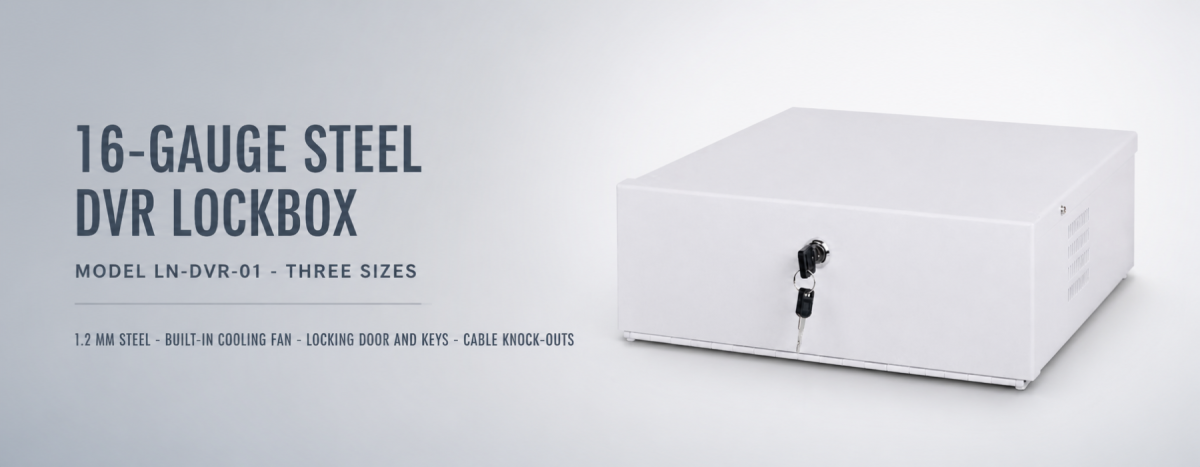
A DVR lockbox is a steel enclosure sized to hold a DVR, VCR, or similar recording equipment behind a locking door. The LN-DVR-01 DVR lockbox is made from 16-gauge heavy-duty steel with a 1.2 mm plate thickness, and ships with a built-in fan, power cord, mounting bolts, rubber feet, and a set of keys.
It is a simple product, and that is the point. There is nothing to configure and nothing to maintain beyond the fan. The enclosure bolts to a wall or shelf, the recorder goes inside, cables run in through the knock-outs, and the door locks.
What a DVR lockbox handles:
- Theft: the recorder is bolted down and behind a lock instead of sitting loose on a shelf.
- Tampering: buttons, ports, and power connections are out of reach.
- Heat: the built-in fan moves air through the enclosure instead of letting it build up.
- Cabling: knock-outs give power, video, and network leads a defined entry point.
- Dust and knocks: the recorder is enclosed rather than open to the room.
What a DVR Lockbox Prevents in Practice
Footage only matters if the recorder is still in place when you go looking for it. In break-ins where the DVR is visible, it tends to leave with everything else, and the recording of the break-in leaves with it. A DVR lockbox bolted to a wall takes time and tools to defeat, and most opportunistic thefts do not involve either.
Internal access is the more common issue, and it rarely involves anyone breaking in. In shops, warehouses, and small offices the DVR often shares a room with stock, cleaning supplies, or staff lockers. A locked DVR lockbox limits access to whoever holds the keys, which also makes it clear who is responsible if footage goes missing.
Heat is the failure people notice last. Drives in a recorder write around the clock, and in a warm room or an enclosed cabinet the temperature climbs. The fan in the LN-DVR-01 DVR lockbox runs off the supplied power connector and cord and keeps air moving through the box, which is the difference between an enclosure that protects a recorder and one that slowly cooks it.
7 Features to Check Before You Order a DVR Lockbox
Enclosures that look identical in a product photo can be very different in the hand. These are the points worth confirming with a supplier before you place an order.
- Steel Gauge and Plate Thickness
Steel thickness decides whether the enclosure resists a pry bar or folds around it. Thin sheet metal dents when it is mounted and flexes at the door edge, which is exactly where a lever goes in. It also warps over time when the box is carrying the weight of a recorder on a wall bracket.
The LN-DVR-01 DVR lockbox uses 16-gauge heavy-duty steel at 1.2 mm thickness. Ask any supplier for the gauge and the thickness in millimetres rather than accepting a description like heavy duty, which means nothing on its own.
- 16-gauge heavy-duty steel construction
- 2 mm plate thickness
- Rigid enough to stay square once mounted
- Sized for DVRs, VCRs, and similar equipment
- Locking Door and Top Cover
The door lock does the day-to-day work. It is what stops a passing hand from hitting the power button or pulling a drive, and it is what you rely on between service visits. The LN-DVR-01 DVR lockbox has a locking door and comes with a set of keys.
The top cover gives you a second option. Screw it down and the enclosure is closed up tight; take the screws out and access is quicker once the door is unlocked. Sites with a real theft risk keep the screws in. Sites where technicians open the box every few weeks usually leave them out.
- Locking door with a set of keys included
- Top cover can be screwed down for extra security
- Screws can be removed for easier access when unlocked
- Decide who holds the keys before the DVR lockboxis installed
- Fan and Ventilation
A steel box with no airflow runs warmer than an open shelf, so cooling is not an optional extra on a DVR lockbox. Recorders generate heat continuously, and drive manufacturers are clear that sustained high temperatures shorten service life.
The LN-DVR-01 DVR lockbox includes a built-in fan and power cord. Check that the fan and its connector come with the enclosure rather than being sold separately: retrofitting a fan means drilling a finished box and finding a power source on site, and neither is a job anyone wants after installation.
- Built-in fan supplied with the enclosure
- Power cord and fan power connector included
- Keeps the temperature down during continuous recording
- No drilling or aftermarket fan kit required
- Cable Entry and Knock-Outs
Cables have to get in somewhere. Knock-outs are pre-formed openings you push out where you need them, which avoids drilling a mounted enclosure and leaving a raw edge against the cable jacket.
The LN-DVR-01 DVR lockbox has knock-outs for cable passes. Open the ones your installation needs and leave the rest closed, so the enclosure stays sealed everywhere else. Tidy cable entry also pays off later: an engineer arriving two years after installation can see at a glance which lead goes where.
- Knock-outs for cable passes, opened only where needed
- No on-site drilling and no filed edges
- Power, video, and network cables enter at defined points
- Easier to trace connections during service visits
- Available Sizes
Size is the detail buyers get wrong most often. Recorders vary in depth, and the connectors and cable bends behind the unit take up more room than the case itself. Measure the recorder with the cables plugged in, then compare that against the internal space, not the external dimensions.
The LN-DVR-01 DVR lockbox comes in three sizes: 15″ x 15″ x 5″, 18″ x 18″ x 5″, and 24″ x 21″ x 8″. The 18″ x 18″ x 5″ model measures 458 mm wide, 458 mm high, and 124.5 mm deep, with bottom mounting holes spaced 418 mm across the width and 387 mm across the depth.
- 15″ x 15″ x 5″ for small DVRs and network devices
- 18″ x 18″ x 5″ for standard recorders, 458 x 458 x 124.5 mm
- 24″ x 21″ x 8″ for larger units or more than one device, 610 x 533 x 203 mm
- Sizes can be customised where a standard option does not fit
- Hardware Supplied with the Enclosure
Missing hardware turns a one-hour job into a trip to the hardware store. Confirm what is in the carton before ordering, particularly the fan connector, which is easy to overlook and awkward to source separately.
The LN-DVR-01 DVR lockbox ships with mounting bolts, rubber feet, a power connector for the fan, and a set of keys. The rubber feet matter if the enclosure sits on a desk or shelf rather than being wall-mounted, since they keep it stable and stop it marking the surface.
- Mounting bolts for wall, rack, or shelf fixing
- Rubber feet for surface-mounted installations
- Power connector for the fan
- A set of keys with every DVR lockbox
- Packaging for Transit
Steel enclosures arrive dented when they are packed badly, and a dented door frame is a door that no longer closes squarely. On container orders this is a real cost, because damaged units are usually unsellable rather than repairable.
The LN-DVR-01 DVR lockbox is packed with four hard fixed white foam pieces holding the unit in place, a PE bag over the product, and a carton box, with the inner carton then packed into an outer carton of the same quality material. Ask any supplier how their enclosures are packed for export before placing a bulk order.
- 4 hard fixed white foam pieces securing the unit
- PE bag over the product
- Inner carton packed into an outer carton
- Same carton quality inside and out
LN-DVR-01 DVR Lockbox Sizes
Measure the recorder first, including connectors and the bend radius of the cables behind it, then choose from the sizes below.
| Size (inches) | W x H x D (inches) | W x H x D (mm, approx.) | Typical use |
| 15″ x 15″ x 5″ | 15 x 15 x 5 | 381 x 381 x 127 | Small DVRs and network devices, tight spaces |
| 18″ x 18″ x 5″ | 18 x 18 x 5 | 458 x 458 x 124.5 | Standard DVRs and recorders |
| 24″ x 21″ x 8″ | 24 x 21 x 8 | 610 x 533 x 203 | Larger units or more than one device |
On the 18″ x 18″ x 5″ model, the lock hole sits 10 mm from the top edge and measures 4.5 mm in diameter, and the bottom mounting holes are spaced 418 mm across the width and 387 mm across the depth. These figures are worth checking against the bracket or wall fixings you plan to use.
DVR Lockbox or the Alternatives
Most sites arrive at a DVR lockbox after trying something else first, so it is worth being specific about why the alternatives fall short.
An open shelf costs nothing and protects nothing. The recorder is visible, reachable, and unplugged in seconds. It is fine in a locked server room with controlled access, and a poor choice anywhere else.
A plastic storage box hides the recorder without securing it. The lid latches rather than locks, the walls flex, and there is no ventilation. Hiding a recorder is not the same as protecting it, and heat build-up makes this option worse than an open shelf in a warm room.
A generic metal cabinet is closer, but the fit is usually wrong. Internal depth rarely matches a recorder with cables attached, there is no fan, cable entry means drilling, and the lock is often a light cam lock. Once you have added a fan, drilled cable entries, and upgraded the lock, you have spent more than a purpose-built DVR lockbox and finished with a worse result.
A DVR lockbox is dimensioned for recorders and arrives with the lock, fan, knock-outs, and mounting hardware already fitted. For most installations that is the whole argument.
Where DVR Lockboxes Get Installed
- Retail stores and supermarkets, where the recorder often sits in a stock room with shared access
- Warehouses and distribution centres, where equipment is exposed in open working areas
- Schools and colleges, where recorders need to be out of reach of students and visitors
- Banks and financial branches, where recorded footage carries evidential weight
- Offices, covering lobby, car park, and comms room recorders
- Apartment buildings, where the system serves many residents and no single occupant
- Petrol stations and car parks, where the recorder is close to a public area
- Government and public buildings, where access to recordings has to be controlled and documented
The common factor is not the building type. It is whether the recorder sits somewhere people can reach it without being challenged.
Footage, Evidence, and Access Control
Recorded footage is often the only account of what happened during a theft, an accident, or a dispute with a customer or supplier. If the recorder is missing when the claim is made, there is no account at all. Insurers and police both ask for footage early, and it is a poor conversation to explain that the recorder was taken along with the stock.
Access control is the second half of it. Retailers, banks, schools, and public bodies are increasingly expected to show that recordings cannot be altered or deleted by whoever happens to be in the room. A keyed DVR lockbox gives a straightforward answer: access is limited to key holders, and forced entry leaves marks on the enclosure.
Choosing the Right DVR Lockbox
Run through this list before ordering. It takes a few minutes and prevents the two most common mistakes, which are ordering the wrong size and ordering an enclosure without a fan.
- Measure the recorder with cables and connectors attached, not just the bare case.
- Ask for the steel gauge and plate thickness in millimetres, such as 16-gauge at 1.2 mm.
- Confirm the door locks, that keys are supplied, and decide who will hold them.
- Check the fan, power cord, and fan connector are included rather than optional.
- Confirm the enclosure has knock-outs so cable entry does not mean drilling on site.
- Check the hardware list covers mounting bolts and rubber feet.
- If equipment may be added later, order the 24″ x 21″ x 8″ size now rather than replacing the box in a year.
Installing a DVR Lockbox
- Pick a position within reach of a power outlet, away from direct sunlight, heating, and anything that leaks.
- Mark the mounting holes, drill pilot holes where needed, and fix the enclosure with the supplied bolts.
- Open only the knock-outs the installation needs and run the cables through them.
- Leave clearance around the recorder so the fan has a path for air to move.
- Connect the fan and check it is turning before the door goes shut.
- Fit the top cover screws if the site needs the extra security.
- Lock the door and record where the spare keys are kept.
With the position agreed and a drill to hand, most installations take under an hour. Deciding where the box goes usually takes longer than mounting it.
Maintenance
There is very little to do, but the fan is worth a look now and then. Dust is what kills airflow, and a blocked fan turns a ventilated enclosure back into a sealed one.
- Clear dust from the fan and vents when you service the recorder.
- Check the door lock and hinges, and ease them with a little lubricant if they stiffen.
- Retighten the top cover screws if the site uses them.
- Look at the cable entries for pinching or strain, particularly after equipment changes.
- Account for the keys and keep the spare somewhere documented.
- Keep boxes and stock away from the enclosure so air can move around it.
Two or three checks a year is enough for most sites, and it can be folded into whatever schedule already covers the recorder itself.
Common Questions
Q: What does a DVR lockbox do?
It holds a DVR, VCR, or similar recorder inside a steel enclosure behind a locking door, so the unit cannot be removed, switched off, or interfered with, and a built-in fan keeps the temperature down while it runs.
Q: Which size should I order?
Measure the recorder with cables attached and compare it against the internal space. The LN-DVR-01 DVR lockbox is available in 15″ x 15″ x 5″, 18″ x 18″ x 5″, and 24″ x 21″ x 8″, which covers most standalone recorders and leaves the largest size for bigger units or two devices.
Q: Will the recorder run hot inside a steel box?
Not with the fan running. The LN-DVR-01 DVR lockbox includes a built-in fan and power cord, and the fan is what makes an enclosed installation viable for equipment recording continuously.
Q: Can it be wall-mounted?
Yes. Mounting bolts are supplied and the enclosure has bottom mounting holes, spaced 418 mm by 387 mm on the 18-inch model, for fixing to a wall, rack, or shelf.
Q: What is in the carton?
The steel enclosure with locking door, a set of keys, the built-in fan with its power connector and power cord, mounting bolts, and rubber feet.
Q: Can the size be customised?
Yes. Three standard sizes are available and custom sizing can be arranged where equipment or the mounting position calls for it.
Q: Does it suit equipment other than DVRs?
It is designed for DVRs, VCRs, and similar electronic equipment, so anything of comparable size that needs to be locked away and ventilated will generally fit.
LN-DVR-01 DVR Lockbox Specification Summary
The full specification for the LN-DVR-01 DVR lockbox is set out below. Figures for width, height, and depth refer to the 18″ x 18″ x 5″ model unless stated otherwise.
| Item | Specification |
| Model | LN-DVR-01 |
| Product | DVR Security Lockbox |
| Application | DVRs, VCRs, and similar electronic equipment |
| Material | 16-gauge heavy-duty steel |
| Plate thickness | 1.2 mm |
| Available sizes | 15″ x 15″ x 5″; 18″ x 18″ x 5″; 24″ x 21″ x 8″ |
| Width (W) | 458 mm |
| Height (H) | 458 mm |
| Depth (D) | 124.5 mm |
| Bottom mounting holes | 418 mm (width) x 387 mm (depth) |
| Lock hole | 10 mm from top edge, 4.5 mm diameter |
| Cooling | Built-in fan with power cord included |
| Door | Locking door, set of keys supplied |
| Top cover | Screw-fixed for extra security, removable for access |
| Cable entry | Knock-outs for cable passes |
| Supplied hardware | Mounting bolts, rubber feet, fan power connector, keys |
| Packing | 4 hard fixed white foam pieces, PE bag, inner carton in outer carton |
Ordering and Custom Sizes
Most buyers order one of the three standard sizes, and for a single recorder in a shop, office, or school that is normally the right call. Where it gets more involved is bulk orders and non-standard equipment.
If you are fitting out multiple sites, settle the size question before the first order rather than after. Recorder models vary between sites more often than people expect, particularly where systems were installed at different times, and an enclosure that fits the newest recorder may be too shallow for an older one. Sending a list of recorder models and dimensions is faster than exchanging photographs.
Custom sizing is available on the LN-DVR-01 DVR lockbox where none of the standard options work, which usually comes up with deeper rack-style recorders, installations that need two devices in one enclosure, or mounting positions with a fixed depth limit. Provide the equipment dimensions and the space you have to work with, and the enclosure can be quoted around them.
- Send recorder make, model, and dimensions with cables attached
- State the mounting position and any depth or width limits
- Confirm quantities per size if you are ordering for several sites
- Say whether the top cover screws are needed, as sites differ on this
Summary
A DVR lockbox is a small line item against the cost of a CCTV installation, and it protects the one component that holds everything the system has recorded. The seven points above cover what separates a usable enclosure from a steel box: steel gauge and thickness, a locking door with a screw-down top cover, a supplied fan, knock-outs for cable entry, a size that actually fits, hardware in the carton, and packaging that survives transit.
The LN-DVR-01 DVR lockbox is built to those specifications: 16-gauge steel at 1.2 mm, locking door with keys, built-in fan and power cord, knock-outs for cable passes, three standard sizes, and mounting bolts and rubber feet supplied. Custom sizes are available where the standard options do not suit.
For sizes, custom options, or wholesale pricing on the LN-DVR-01 DVR lockbox, get in touch with the recorder model and dimensions you are working with and we will confirm the right fit.