Walk into any modern data center, server room, or network closet and the first piece of hardware you notice is likely a rack. Among all the options available today, the floor network open rack has quietly become the go-to choice for businesses that need flexible, accessible, and cost-effective equipment housing. Unlike enclosed cabinets with lockable steel doors, an open-frame design removes the front and rear panels entirely — and that single change has surprisingly far-reaching effects on how you cable, cool, and expand your infrastructure.
This guide covers everything worth knowing before you buy: what a floor network open rack actually is, how to read the specifications that matter, what distinguishes a well-engineered unit from a cheap imitation, and how the LNWORE-A series fits into real-world deployments. Whether you’re outfitting a small office, a school lab, or an edge computing site, the principles here stay the same.
 What Is a Floor Network Open Rack?
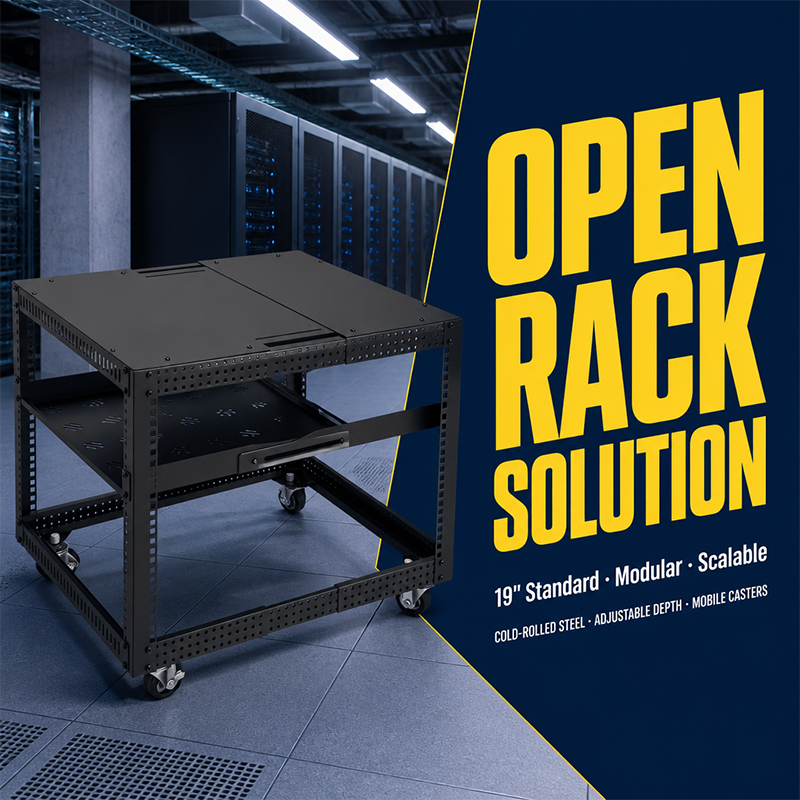
A floor network open rack is a freestanding, four-post mounting frame built to the universal 19-inch EIA-310 standard. It holds switches, patch panels, 1U servers, power distribution units, and virtually any rackmountable equipment. The defining characteristic is openness: without solid side panels or doors, technicians can reach cables and devices from any angle without opening a cabinet.
The term “floor” distinguishes it from wall-mount brackets and shallow wall-mount cabinets. A floor network open rack sits directly on the ground — or on optional casters — making it suitable for heavier equipment loads and taller configurations starting at 10U and going well beyond.
You’ll encounter this product under several names depending on the vendor: open-frame rack, open rack, 4-post open rack, network open rack, or server open rack. All of them describe the same fundamental design. What separates a good one from a poor one comes down to material thickness, rail geometry, structural rigidity, and the quality of the accessories that ship in the box.
Why Choose an Open Frame Instead of an Enclosed Cabinet?
This is the question most buyers ask first, and the honest answer is: it depends entirely on your environment. Open racks are not universally superior, but they do win in several important scenarios.
Easier Cable Access
With no doors or side panels, a floor network open rack gives you unobstructed access to every port, every cable, and every piece of equipment from three sides simultaneously. In environments where moves, adds, and changes happen frequently — think growing offices, school IT rooms, or co-working spaces — this accessibility alone can cut patching time by a significant margin.
Better Natural Airflow
Enclosed cabinets require fan trays or air management systems to prevent hotspots. An open-frame design lets ambient air circulate freely around all equipment. This is particularly relevant for lighter deployments where active cooling adds unnecessary cost and noise.
Lower Upfront Cost
Fewer materials mean a lower price point. A well-built floor network open rack consistently costs less than a comparable enclosed cabinet of the same U height, making it attractive for startups, educational institutions, and businesses running lean IT budgets.
When to Choose an Enclosed Cabinet Instead
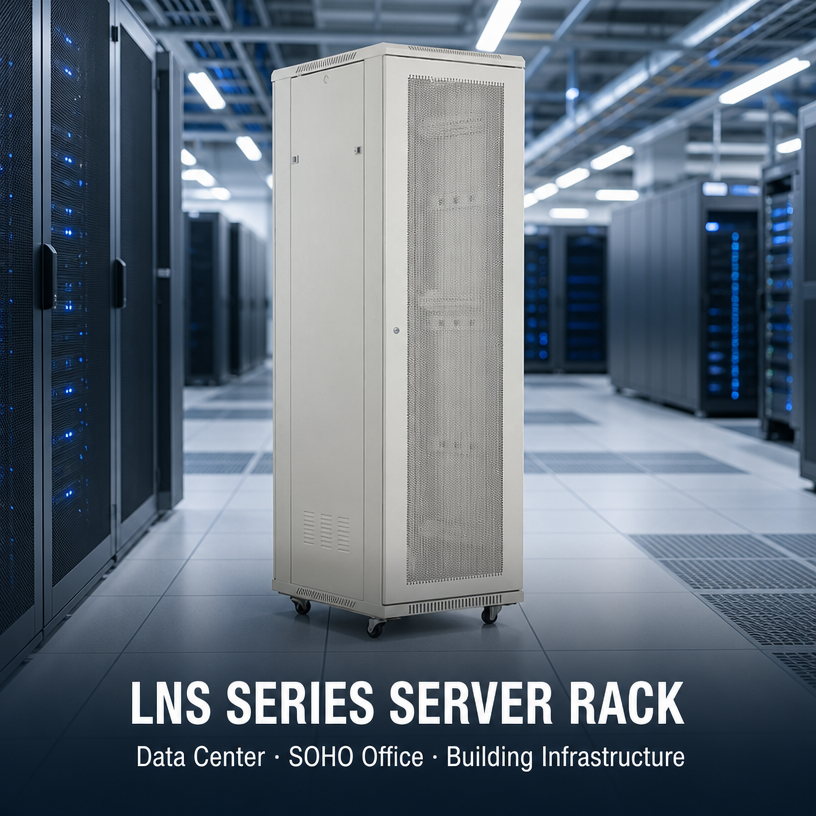
Open racks are not the right answer when physical security is a hard requirement — if unauthorized hands can reach equipment, you need a locked cabinet. Dusty industrial environments and spaces with high humidity also favor enclosures. For office lobbies or public-facing areas, the visual tidiness of an enclosed cabinet usually wins out. Know your environment before committing.
Key Specifications Explained
Rack spec sheets can be dense with acronyms and measurements. Here’s how to read the numbers that actually matter when shopping for a floor network open rack.
U Capacity
“U” stands for rack unit, where 1U equals 44.45 mm of vertical mounting space. A 10U rack gives you room for ten 1U devices or a mix of devices with different heights. The LNWORE-A series ships in 10U, 15U, and 20U configurations, covering the range from a small branch office patch bay to a moderately loaded server environment. If you’re deploying a new site, it’s generally wiser to go one size up — adding capacity later means buying another rack.
Depth and Depth Adjustment
Standard network switches are shallow; modern 1U servers can exceed 700 mm in depth. A quality floor network open rack addresses this with adjustable depth rails. The LNWORE-A achieves this through side beam adjustment holes spaced at 15 mm intervals, allowing the mounting depth to extend up to 802 mm — enough to comfortably accommodate nearly any current-generation rackmount server without the need for extended rail kits.
Material and Thickness
Steel quality is where budget products cut corners most aggressively. SPCC cold-rolled steel is the industry baseline for racks, prized for its uniform grain structure and predictable yield strength. Thickness matters more than raw material labeling: the LNWORE-A uses ≥ 1.2 mm for both the rails/beams and the frame. This is the minimum you should accept for any floor network open rack that will hold production equipment. Thinner steel — 0.8 mm or 1.0 mm — shows as flex and vibration under load, particularly when casters are fitted and the rack is moved.
Load Capacity
Load ratings on open racks are affected by material thickness, weld/bolt quality, and how the weight distributes across rails. Always check whether the listed load capacity is static (rack standing still) or dynamic (rack on casters in motion), as dynamic ratings are always lower. For a 20U floor network open rack loaded with servers, ensure the frame rating comfortably exceeds your anticipated equipment weight with a margin to spare.
Packing and Flat-Pack Design
A modular, flat-packed design means lower shipping costs and easier single-person installation. The LNWORE-A ships in a flat-pack box — the 10U model packs down to 549 × 514 × 150 mm at 13.7 kg, while the 20U packs to 729 × 566 × 150 mm at 18.7 kg. These dimensions make it entirely feasible to transport by standard courier without freight truck arrangements.
Five Features That Separate a Good Floor Network Open Rack from a Poor One
There are hundreds of open rack products on the market. These five differentiators help narrow the field quickly.
1. Structural Rigidity Under Real Load
A floor network open rack without panels derives all its rigidity from the quality of the steel frame and how its cross-members are joined. Look for welded or precision-bolted corners rather than simple tab-and-slot assemblies that rely on the equipment itself to keep the frame square. Rack that flex mid-installation make cable runs unreliable and create long-term stress on equipment mounting ears.
The LNWORE-A’s modular assembly structure is engineered for fast deployment without sacrificing rigidity. The bottom crossbeams are heavy-gauge and the rail geometry holds square during assembly — a detail that becomes obvious when you compare it against lower-cost alternatives during the build process.
2. Intelligent Ventilation Design
Even though an open rack has no enclosed airspace, thermal management remains relevant. Equipment at the bottom of a fully loaded rack benefits from airflow separation to prevent hot air recirculation from devices above it.
The LNWORE-A addresses this with dedicated 1U ventilation blanking panels at both the top and bottom of the frame. Blanking panels in an open rack serve a different purpose than in a closed cabinet — they guide the stack of equipment and encourage organized airflow channels between device groups. Many cheaper racks ship with no blanking panels at all, leaving this detail to the installer.
3. Flexible Depth for Mixed Equipment
One of the most common frustrations with entry-level open racks is fixed rail depth. A floor network open rack with truly adjustable depth — using precision-spaced holes rather than slotted compromises — makes it possible to mix shallow patch panels with deep servers on the same frame without improvised extensions.
The 15 mm hole spacing on the LNWORE-A’s side beam adjustment system gives fine-grained control over mounting position. Combined with the maximum adjustable depth of 802 mm, this rack handles both 300 mm-deep patch panels and 750 mm-deep 2U servers side by side in the same frame.
4. Practical Extras That Reduce Installation Time
Several small design decisions dramatically cut the time from unboxing to live deployment:
- The sliding cover on the top panel keeps dust out of the equipment stack while remaining out of the way when you’re working — a simple feature that gets quietly appreciated after the first month.
- A 350 mm deep sliding shelf in the mid-rack position provides a convenient staging area for equipment that doesn’t have rack ears, such as UPS batteries, small NAS units, or test laptops.
- Four expansion screw fixing points on the back of the frame allow the floor network open rackto be anchored directly to a wall when required for seismic compliance or stability in mobile environments.
- Optional 2-inch universal casters convert the static unit into a mobile rack immediately, useful for lab environments or temporary deployments where the rack needs to move between rooms.
5. Complete Hardware Kit in the Box
It sounds minor, but many racks ship without mounting hardware, forcing a last-minute trip to the hardware store before you can install equipment. The LNWORE-A includes 20 sets of equipment mounting screws plus 4 sets of expansion screws for wall anchoring — enough to fill the rack and secure it without supplementary purchases.
LNWORE-A Series: Model Comparison at a Glance
The LNWORE-A floor network open rack is available in three heights to match different deployment scales:
| Model | Capacity | Dimensions W×D×H (mm) | Flat-Pack Size (mm) | Packed Weight |
| LNWORE-A-10U | 10U | 512 × 505 × 446 | 549 × 514 × 150 | 13.7 kg |
| LNWORE-A-15U | 15U | 512 × 505 × 668 | 639 × 540 × 150 | 16.2 kg |
| LNWORE-A-20U | 20U | 512 × 512 × 891 | 729 × 566 × 150 | 18.7 kg |
All three models share the same SPCC steel construction, ≥ 1.2 mm frame thickness, adjustable depth rails, top sliding cover, mid sliding shelf, and ventilation blanking panels. The differences are purely in height and the resulting shipping footprint.
Installation Tips for a Floor Network Open Rack
Getting the most out of a floor network open rack comes down to a few basic practices that are easy to overlook when you’re racing to get equipment live.
Plan Your U Layout Before Installing Equipment
Draw a simple U diagram on paper first. Place heavier equipment — switches, UPS units — toward the bottom to lower the center of gravity, especially if you’re fitting casters. Patch panels work best at the top where cable drops are shortest. Reserve one or two blank U positions for future expansion even if the rack feels full now.
Use the Depth Adjustment Before Mounting Rails
Set your rail depth to match the deepest equipment in the rack before installing anything. Adjusting depth on a loaded floor network open rack means removing equipment first — a frustrating experience that’s entirely avoidable with five minutes of planning upfront.
Secure the Frame to the Floor or Wall
Even a relatively light 10U floor network open rack can tip if a drawer is fully extended and a technician leans on it. Use the built-in expansion screw fixing points on the rear of the LNWORE-A frame to anchor the rack to the wall when the installation environment allows it. For caster-mounted versions in mobile use, engage the caster locks whenever the rack is stationary.
Label Everything at Installation Time
Open racks make cables visible — which is both an advantage and a disadvantage. Without clear labeling, an open floor network open rack can become a tangle of cables that is harder to trace than an equivalent enclosed cabinet. Print labels for every patch cable and power cord before insertion. This discipline pays back hours of troubleshooting time later.
Where a Floor Network Open Rack Makes the Most Sense
Understanding the right environment for a floor network open rack prevents buyer’s remorse and ensures the product earns its place over years of use.
Small and Medium Business Server Rooms
An SMB running a handful of servers, a core switch, and a small UPS doesn’t need the expense of a full enclosed cabinet. A 20U floor network open rack provides enough capacity for a typical sub-ten-employee office’s entire infrastructure stack. The open design means the IT generalist managing it — who is likely not a dedicated network engineer — can immediately see what connects where.
School and University IT Labs
Educational institutions frequently reconfigure their network infrastructure between terms. A floor network open rack on casters allows the equipment stack to be relocated to a different lab room without disassembly. The 15U LNWORE-A model, for instance, fits a core switch, two access switches, a firewall, and a patch panel within a footprint no larger than a small filing cabinet.
Retail and Pop-Up Deployments
Retail IT environments cycle through seasonal setups. A lightweight, flat-packable floor network open rack can be assembled, deployed, and broken down within an hour. The LNWORE-A-10U, packed at just 13.7 kg, ships economically by standard courier — practical for retail chains deploying standardized equipment to multiple locations.
Edge Computing and Industrial IoT
Edge nodes often live in spaces that weren’t designed as server rooms: back offices, utility closets, factory floor annexes. A floor network open rack fits these environments better than a full-height enclosed cabinet. The adjustable depth and optional wall-mount anchor points on the LNWORE-A make it adaptable to irregular spaces where a standard cabinet simply doesn’t fit.
Home Lab and Development Environments
Home lab enthusiasts increasingly favor open racks for the same reason professionals do: cable visibility and easy access. A 10U or 15U floor network open rack in a home office or basement lab allows hardware to be swapped, upgraded, and re-cabled without the hassle of cabinet door clearance. The modest footprint of the LNWORE-A series — 512 mm wide — fits comfortably alongside a desk.
What to Watch Out For When Buying a Floor Network Open Rack
The floor network open rack market has a wide quality range. These are the red flags worth checking before committing to a purchase.
- Steel thickness not stated or listed below 1.2 mm. Racks built from 0.8 mm material flex visibly under even modest loads.
- No hardware included. A rack that ships with no mounting screws forces an immediate secondary purchase and suggests cost-cutting on components that aren’t easily visible.
- Fixed depth only. Any floor network open racklacking adjustable rail depth is a gamble that all your current and future equipment will fit the same dimension.
- Weight rating absent from the spec sheet. If a manufacturer doesn’t publish a load rating, assume it hasn’t been tested.
- No flat-pack option for large sizes. A 20U open rack that ships fully assembled adds significant freight cost compared to a flat-pack equivalent — for no functional benefit.
Maintenance and Long-Term Reliability
A well-built floor network open rack requires almost no maintenance beyond occasional cleaning. Steel frames with quality powder-coat finishes resist corrosion for years in normal indoor environments. The main long-term considerations are:
- Caster bearing wear if the rack is moved frequently. Replace casters before a bearing fails under load rather than after.
- Rail thread wear at mounting points. Keep spare M6 cage nuts or mounting screws on hand — they’re inexpensive and a worn thread causes immediate headaches when equipment needs to be reseated.
- Blanking panel displacement. In open racks, blanking panels can shift over time if people lean equipment against them during installation. Spend thirty seconds checking their position annually.
For production environments, it’s good practice to document the load in each U position and verify that the total weight remains within the rack’s rated capacity as equipment is upgraded over time. A switch replaced with a denser model or additional storage added to an existing server can quietly push a rack past its designed limit.
Final Thoughts
A floor network open rack is one of the few pieces of infrastructure that, once properly sized and installed, rarely needs to be thought about again. The combination of open access, natural airflow, and straightforward scalability makes it the practical default for any environment where physical security isn’t the primary concern.
The LNWORE-A series makes a genuine case for itself on the details that matter most: ≥ 1.2 mm SPCC cold-rolled steel throughout, depth adjustability up to 802 mm, practical built-in accessories like the sliding shelf and ventilation panels, and a flat-pack shipping format that keeps logistics costs reasonable. Whether you need a compact 10U unit for a retail site or a 20U floor network open rack for a growing server room, the three-model lineup provides a direct answer without forcing a compromise.
Buy for your current load, plan for the next two years, and install it properly the first time. A good floor network open rack chosen with care will still be reliably doing its job a decade from now.