As data centers evolve to handle higher densities and more critical workloads, thermal management has become a top priority for IT infrastructure managers. Among the various solutions available, Cold aisle containment (also widely known as CAC) stands out as one of the most effective strategies for optimizing cooling performance and reducing operational costs. By creating a physical barrier that separates cold supply air from hot exhaust air, a Cold aisle containment (CAC) system ensures that your servers receive the precise cooling they need without wasting energy.
In this guide, we will explore the core features and benefits of a professional Cold aisle containment (CAC) system and why it is essential for modern data center environments.
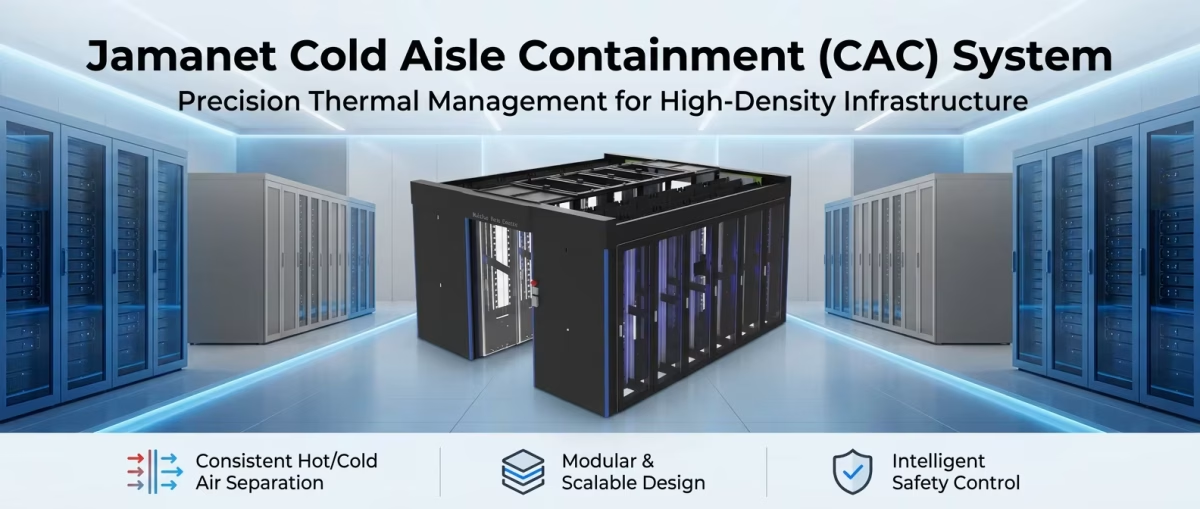 1. Consistent Separation of Cold and Hot Air
The primary goal of any Cold aisle containment (CAC) strategy is to eliminate the mixing of cold and hot air streams. In a traditional open-aisle setup, “bypass air” and “re-circulation” often lead to hot spots and inefficient cooling. A well-designed CAC system uses modular panels and doors to seal the cold aisle, ensuring that 100% of the cold air delivered by the AC units is directed through the server equipment.
This consistent separation provided by Cold aisle containment results in:
- Significant energy savings by allowing higher set-points for AC units.
- Protection of sensitive IT gear from thermal stress.
- Elimination of hot spots, even in high-density rack configurations.
2. Precision Climate Control with Over-Pressure Design
A professional Cold aisle containment (CAC) solution, such as the Jamanet Containment system, often incorporates an over-pressure design. This means the pressure inside the sealed CAC area is slightly higher than the surrounding room. This ensures that the blow-in temperature from the air conditioner remains almost identical to the temperature at the front of the servers.
Key technical advantages of this CAC design include:
- No Temperature Layering:Inside the Cold aisle containment, there is no temperature layering in front of the 19″ plane, providing uniform cooling from the bottom to the top of the rack.
- Optimized Temperature:The absence of sub-cooling allows for precise optimization of the data center’s overall temperature profile.
- Higher Packing Density:With the same climate control elements, CAC allows for higher equipment density per network cabinet without risking overheating.
3. Modular and Scalable Configuration
One of the standout features of a modern CAC system is its flexibility. Data centers are rarely static, and your cooling solution should be able to grow with your needs. The Jamanet Cold aisle containment utilizes modular standard components that enable flexible adaptation to various IT requirements.
Specifications that offer this CAC flexibility include:
- Variable Network Cabinet Heights:Support for network cabinets ranging from standard sizes up to a massive 60U
- Flexible Widths:Compatible with both 600 mm and 800 mm wide network cabinets.
- Standardized Aisle Width:Optimized for a 1200 mm aisle width to ensure comfortable technician access while maintaining cooling efficiency.
- Ease of Expansion:The base system is simple to combine and modify, making it an ideal configuration basis for individual CAC
4. Advanced Safety and Intelligent Access Control
Safety and security are integrated into every aspect of a high-quality Cold aisle containment (CAC) system. From fire suppression compatibility to secure access, these systems are designed to protect both the equipment and the facility.
- Automatic Ceiling Windows:In the event of a fire, the CAC top covers open automatically. This allows external sprinkler systems to effectively reach the equipment. In normal operation, these windows are held shut by electromagnets.
- Electronic Sliding Doors:For secure and convenient access, CAC systems can be equipped with electronic sliding doors. These can be activated by motion sensors or integrated with access control systems (using mechanical or electronic locks).
- Safety Glass:Both doors and windows typically feature 10 mm or 5 mm laminated safety glass, providing durability and clear visibility for maintenance teams.
5. Global Reliability and High ROI
Implementing a Cold aisle containment (CAC) system is not just a technical upgrade; it is a smart financial investment. With low initial investment costs and virtually zero maintenance expenses, the ROI (Return on Investment) for CAC is remarkably short.
The reliability of these systems is proven globally, with successful Cold aisle containment projects deployed in:
- Netherlands and Spain
- Russia and Canada
- Australia and Britain
By choosing a preconfigured CAC solution, organizations can minimize implementation time and investment risk, thanks to completely matched climate control components.
Conclusion
A well-implemented Cold aisle containment (CAC) system is more than just a physical enclosure; it is a critical component of a high-performance data center. By ensuring consistent air separation, enabling precision climate control, and offering modular scalability, CAC helps IT managers achieve the perfect balance between performance and energy efficiency.
Whether you are managing a small server room or a large-scale enterprise data center, investing in a robust CAC solution will protect your IT assets and drive long-term operational savings.
If you are looking for a customizable and efficient Cold aisle containment system for your next project, choosing a solution that prioritizes modularity, safety, and proven thermal performance is the key to success.