When IT managers, network engineers, and system integrators begin planning a new deployment, one of the first decisions they face is selecting the right rack unit (U) size for their wall-mount enclosure. Whether you need a compact 4U cabinet for a single-switch installation, a 6U cabinet for a small office network, a 9U cabinet for a branch office, a 12U cabinet for a mid-sized deployment, a 15U cabinet for a growing infrastructure, or an 18U cabinet for a full-featured edge computing node, choosing the correct size from the outset saves money, reduces installation complexity, and prevents costly replacements down the line.
This comprehensive guide walks through every size category in the LNWK Series wall-mount network cabinet range — from the 4U cabinet up to the 18U cabinet — covering specifications, ideal applications, selection criteria, and key features that make each size the right tool for a specific set of requirements. By the end of this guide, you will have a clear picture of which U-size is right for your project, and what to look for in the cabinet itself beyond the simple question of capacity.
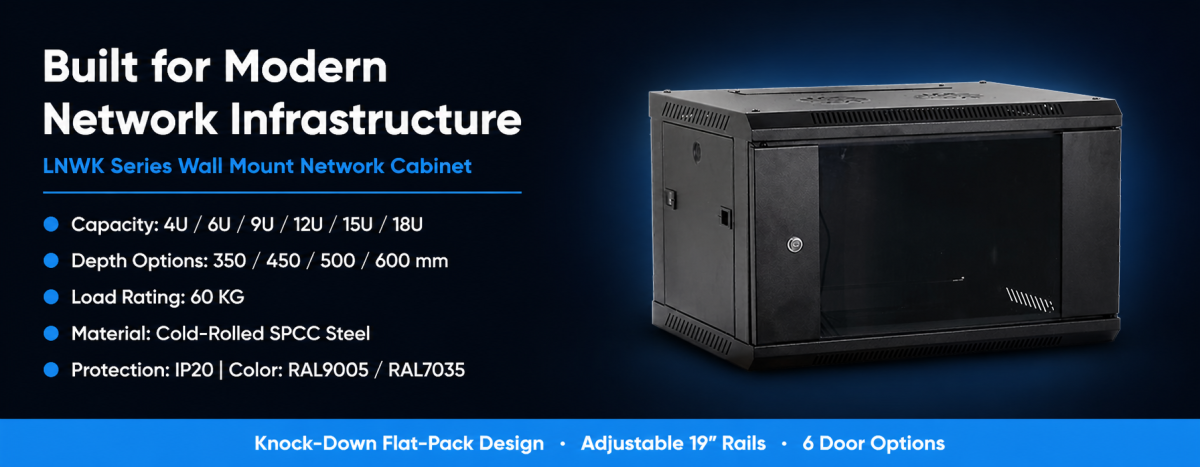
The LNWK Series is a professionally engineered knock-down wall-mount network cabinet range manufactured from cold-rolled SPCC steel, rated for a maximum load of 60 KG, and available in six height configurations: 4U cabinet, 6U cabinet, 9U cabinet, 12U cabinet, 15U cabinet, and 18U cabinet. Each size is available in multiple depth and width options, giving specifiers and installers the flexibility to match the enclosure precisely to the equipment being deployed.
 1. Understanding Rack Units: What Does U Actually Mean?
Before diving into individual size categories, it is worth establishing a clear understanding of what rack units measure and why they matter when selecting a 4U cabinet, 6U cabinet, 9U cabinet, 12U cabinet, 15U cabinet, or 18U cabinet.
A rack unit, abbreviated as U, is a standardised unit of measurement for rack-mountable equipment. One rack unit equals exactly 44.45 mm (1.75 inches) of vertical mounting height. This measurement is defined by the EIA-310 standard and is universally followed by networking and server equipment manufacturers. When you see a managed switch labelled as 1U, it occupies 44.45 mm of vertical space in the rack. A patch panel labelled as 2U occupies 88.9 mm.
The U designation on a cabinet — such as 4U cabinet or 12U cabinet — refers to the total usable mounting height inside the enclosure. A 9U cabinet, for example, provides 9 × 44.45 mm = 400 mm of usable rack space for equipment. The external height of the cabinet will always be somewhat larger than the internal rack space, to accommodate the top and bottom panels, cable entry areas, and mounting hardware.
Understanding this relationship is essential for accurate capacity planning. Always calculate the total U requirements of your planned equipment list before choosing between a 6U cabinet, 9U cabinet, or 12U cabinet — then add buffer capacity for future growth.
The 19-inch rail standard is equally important. Every LNWK Series cabinet — whether a 4U cabinet or an 18U cabinet — features 19-inch profile rails with U-position markings, ensuring compatibility with all standard 19-inch rack-mountable equipment from any manufacturer.
2. The 4U Cabinet: Maximum Compactness for Minimal Deployments
The 4U cabinet is the smallest practical wall-mount network enclosure in the professional range. With four rack units of internal mounting space, the 4U cabinet is designed for installations where the network infrastructure is genuinely minimal and floor or wall space is extremely limited.
2.1 What Fits in a 4U Cabinet?
Despite its compact dimensions, a well-planned 4U cabinet installation can house a complete small network node:
- 1U patch panel (8-port or 12-port) for structured cabling termination
- 1U small managed or unmanaged switch for end-device connectivity
- 1U fibre media converter or wireless access point controller
- 1U blanking panel for cable management and airflow control
This configuration covers the networking needs of a single room, a small retail kiosk, a hotel floor distribution point, or a remote monitoring node. The 4U cabinet is also commonly used in AV and CCTV installations where a small controller, DVR, and switch need to be co-located in a secure and tidy enclosure.
2.2 When to Choose a 4U Cabinet
- The network node serves fewer than 12 devices at the point of installation
- Available wall space is restricted to a very small area
- The installation must be as discreet as possible
- There is no expectation of significant future expansion at this location
- The enclosure is part of a distributed network with centralised infrastructure elsewhere
One important consideration when specifying a 4U cabinet is cable management. With only four rack units of space, cable entry, routing, and organisation need to be planned very carefully to avoid the cabinet becoming congested. The LNWK Series 4U cabinet includes top and bottom cable entry openings with removable metal covers, which allows clean cable ingress from both directions even in this compact format.
3. The 6U Cabinet: The Most Popular Choice for Small Office Networks
The 6U cabinet is by far the most commonly specified wall-mount network enclosure for small office and commercial applications. It offers enough capacity to house a complete small-to-medium office network infrastructure, while remaining compact enough to fit in a communications cupboard, above a door frame, or in a corner of a server room.
3.1 LNWK Series 6U Cabinet Specifications
The LNWK Series offers three 6U cabinet configurations, covering different width and depth requirements:
| Model | External Dimensions W×D×H (mm) | KD Pack Size W×D×H (mm) | Net Weight (kg) |
| LNWK 5406 | 540 × 450 × 350 | 560 × 470 × 285 | 14.5 |
| LNWK 6406 | 600 × 450 × 350 | 620 × 470 × 285 | 15.5 |
| LNWK 6506 | 600 × 500 × 350 | 620 × 500 × 285 | 18.0 |
3.2 What Fits in a 6U Cabinet?
A 6U cabinet comfortably accommodates the networking infrastructure for a small office of 20 to 30 workstations:
- 1U 24-port patch panel for structured cabling
- 1U managed switch with 24 PoE ports for workstations and IP phones
- 1U router or firewall appliance
- 1U fibre patch panel or media converter shelf
- 1U cable management tray or horizontal cable manager
- 1U blanking panel for airflow management
This standard 6U cabinet layout represents one of the most common professional small-office network deployments in the industry. It is clean, tidy, and fully contained within a single 6U cabinet without any compromises on cable management or equipment access.
3.3 Depth Selection for the 6U Cabinet
All three LNWK 6U cabinet models have an external height of 350 mm and offer varying depths. The 450 mm depth (LNWK 5406 and LNWK 6406) suits most 1U managed switches and passive equipment. The 500 mm depth (LNWK 6506) accommodates slightly deeper equipment and provides more internal routing space for rear cable connections. The 19-inch profile rails in every LNWK 6U cabinet are adjustable in depth, ensuring equipment of varying lengths can be correctly supported regardless of which depth option is chosen.
4. The 9U Cabinet: Ideal for Branch Offices and Distributed Deployments
The 9U cabinet strikes a balance between compact size and meaningful capacity. With nine rack units of internal mounting space, the 9U cabinet can house a complete branch office network, including core switching, edge routing, structured cabling termination, and even a small rack-mount UPS for power protection.
4.1 LNWK Series 9U Cabinet Specifications
| Model | External Dimensions W×D×H (mm) | KD Pack Size W×D×H (mm) | Net Weight (kg) |
| LNWK 5609 | 540 × 600 × 483 | 560 × 620 × 285 | 20.0 |
| LNWK 6409 | 600 × 450 × 483 | 620 × 500 × 285 | 21.5 |
| LNWK 6509 | 600 × 500 × 483 | 620 × 520 × 285 | 24.0 |
4.2 What Fits in a 9U Cabinet?
A 9U cabinet provides substantially more flexibility than a 6U cabinet, particularly for installations that need to accommodate multiple switches or a rack-mount power protection device:
- 2 × 1U 24-port patch panels for up to 48 structured cabling ports
- 1U managed PoE switch for workstations and IP phones
- 1U second switch for server or storage connectivity
- 1U router or unified threat management (UTM) firewall
- 1U rack-mount UPS (650 VA or 1000 VA, depending on depth)
- 1U horizontal cable manager
- 2U spare capacity for future equipment or expansion
The 9U cabinet is a particularly popular choice for retail chains, hospitality groups, and professional services firms managing multiple branch locations. Its capacity is sufficient for a complete branch office infrastructure, and its wall-mount format avoids the need for a dedicated server room at each site.
4.3 The 9U Cabinet in Edge Computing
Edge computing deployments increasingly rely on compact wall-mount enclosures at the network edge. A 9U cabinet can house a small 1U edge server, a managed switch, a fibre media converter, and a UPS in a single secure enclosure — making it one of the most versatile formats in the LNWK Series range. The LNWK 5609 model, with its 600 mm depth, is specifically suited to edge deployments where full-depth compute equipment must be accommodated within a wall-mount 9U cabinet.
5. The 12U Cabinet: The Standard Choice for Mid-Sized Installations
The 12U cabinet is arguably the most versatile size in the wall-mount network enclosure category. It provides enough capacity for a complete mid-sized office network, including redundant equipment and comprehensive structured cabling, while remaining within the dimensions of a wall-mount enclosure rather than requiring a floor-standing rack.
5.1 LNWK Series 12U Cabinet Specifications
| Model | External Dimensions W×D×H (mm) | KD Pack Size W×D×H (mm) | Net Weight (kg) |
| LNWK 5612 | 540 × 600 × 617 | 630 × 560 × 285 | 26.0 |
| LNWK 6412 | 600 × 450 × 617 | 620 × 620 × 285 | 27.5 |
| LNWK 6512 | 600 × 500 × 617 | 630 × 620 × 285 | 30.0 |
5.2 What Fits in a 12U Cabinet?
With twelve rack units of capacity, a 12U cabinet can house a sophisticated and fully redundant network infrastructure:
- 2 × 1U patch panels providing 48 structured cabling ports
- 1U core managed switch with 48 PoE ports
- 1U distribution switch or aggregation layer device
- 1U enterprise-grade router or SD-WAN appliance
- 1U rack-mount UPS (1000 VA or 1500 VA)
- 1U network attached storage (NAS) for local backup
- 1U KVM switch or out-of-band management device
- 1U horizontal cable manager
- 2U spare capacity for growth and future additions
- 1U blanking panels for unused positions
The 12U cabinet is the natural choice for offices of 40 to 80 workstations, schools with a single network distribution point, healthcare clinics, and small industrial facilities. It is also widely used in telecommunications infrastructure installations where a 12U cabinet houses DSLAMs, fibre termination equipment, and local switching in a single secure wall-mount enclosure.
5.3 Cage Nut Provision in the 12U Cabinet
The LNWK Series 12U cabinet ships with 12 sets of cage nuts included as standard, matching the standard rail count for a fully populated 12U installation. This is a practical detail that experienced installers appreciate — arriving on site with the correct fixings already in the box saves time and avoids the frustration of sourcing cage nuts separately. For models larger than 12U, the supply increases to 24 sets.
6. The 15U Cabinet: Expanding Capacity Without Going Floor-Standing
The 15U cabinet represents a significant step up in capacity that many installers do not initially consider — often jumping directly from a 12U cabinet to a floor-standing rack. In reality, the 15U cabinet occupies a valuable middle ground: it provides substantially more equipment space than a 12U cabinet while remaining a wall-mount format that avoids the cost and complexity of a dedicated server room build-out.
6.1 LNWK Series 15U Cabinet Specifications
| Model | External Dimensions W×D×H (mm) | KD Pack Size W×D×H (mm) | Net Weight (kg) |
| LNWK 5615 | 540 × 600 × 750 | 770 × 620 × 285 | 33.5 |
| LNWK 6415 | 600 × 450 × 750 | 770 × 520 × 285 | 36.5 |
| LNWK 6515 | 600 × 500 × 750 | 770 × 620 × 225 | 39.5 |
6.2 What Fits in a 15U Cabinet?
The three extra rack units in a 15U cabinet compared to a 12U cabinet might sound modest, but in practice they make a significant difference to the completeness and future-proofing of the installation:
- 2 × 1U patch panels with 48 structured cabling ports
- 1U core managed switch with 48 PoE ports
- 1U access switch for a secondary floor or department
- 1U router or unified security gateway
- 2U rack-mount UPS (1500 VA or 2000 VA)
- 1U NAS for local data storage and backup
- 1U dedicated wireless LAN controller
- 1U horizontal cable manager (top) + 1U vertical cable manager equivalent
- 1U console server or out-of-band management switch
- 3U spare capacity for future growth
The 15U cabinet is particularly well-suited to deployments that have grown beyond what a 12U cabinet can comfortably accommodate, or to new installations where the equipment list is already pushing the limits of a 12U design. Healthcare facilities, professional services firms, hospitality venues with multiple network requirements, and educational institutions with growing device inventories are all typical users of a 15U cabinet.
6.3 Weight Considerations for a 15U Cabinet
A fully populated 15U cabinet can be a substantial assembly. With a net cabinet weight of 33.5 to 39.5 kg (depending on model) plus the weight of installed equipment, a fully loaded 15U cabinet may approach or exceed 60 kg — the rated load capacity of the LNWK Series. Wall structure assessment and appropriate fixing specification are particularly important for 15U cabinet installations, and L-shaped wall mounting brackets should be considered as standard for additional safety margin.
7. The 18U Cabinet: Maximum Wall-Mount Capacity for Demanding Deployments
The 18U cabinet is the largest wall-mount network enclosure in the LNWK Series range, and represents the upper practical limit of what can be safely and ergonomically wall-mounted in a professional installation. An 18U cabinet offers a capacity that rivals many small floor-standing racks, while retaining the space-saving and access advantages of a wall-mount format.
7.1 LNWK Series 18U Cabinet Specifications
| Model | External Dimensions W×D×H (mm) | KD Pack Size W×D×H (mm) | Net Weight (kg) |
| LNWK 6418 | 600 × 450 × 884 | 905 × 620 × 285 | 37.0 |
| LNWK 6518 | 600 × 500 × 884 | 905 × 620 × 285 | 41.0 |
| LNWK 6618 | 600 × 600 × 884 | 905 × 620 × 285 | 44.0 |
7.2 The Unique 600 mm Depth Option in the 18U Cabinet
The LNWK 6618 is the only model in the entire LNWK Series to offer a 600 mm external depth, making it the deepest wall-mount network cabinet in the range. This additional depth is specifically designed for the 18U cabinet configuration, where high-capacity enterprise switches, full-depth rack-mount servers, and larger UPS units may need to be accommodated. The 600 mm depth brings the 18U cabinet close to the depth of many entry-level floor-standing rack options, making it a compelling alternative for deployments that do not need the full height of a 42U rack.
7.3 What Fits in an 18U Cabinet?
An 18U cabinet can accommodate a complete enterprise network node for a medium-sized office or a sophisticated edge computing deployment:
- 3 × 1U patch panels providing 72 structured cabling ports
- 1U core managed switch with 48 PoE+ ports
- 2 × 1U access switches for floor or department distribution
- 1U enterprise router with SD-WAN capability
- 2U rack-mount UPS (2000 VA or 3000 VA)
- 1U 1RU server or compact compute node
- 1U NAS or backup appliance
- 1U dedicated wireless LAN controller
- 1U monitoring or out-of-band management device
- 2U horizontal cable managers (top and mid-cabinet)
- 3U spare capacity for future expansion
The 18U cabinet is the preferred choice for organisations that need maximum capacity in a wall-mount format, for installations where a floor-standing rack is impractical due to space or lease restrictions, and for edge computing deployments where a compact but fully featured infrastructure node is required at a remote or branch site.
8. Comparing All Six Sizes: How to Make the Right Choice
With six size options from 4U cabinet to 18U cabinet, selecting the right LNWK Series model requires a structured decision process. The following comparison framework helps narrow down the options based on real-world deployment requirements.
| Cabinet Size | Typical Deployment | Max Structured Cabling Ports | Network Nodes Served | Recommended For |
| 4U cabinet | Single room / kiosk | Up to 12 | < 10 devices | Retail kiosk, AV node, CCTV hub |
| 6U cabinet | Small office / branch | Up to 24 | Up to 30 | SME office, classroom, clinic room |
| 9U cabinet | Branch office / edge node | Up to 48 | Up to 60 | Retail branch, hotel floor, edge compute |
| 12U cabinet | Mid-office / main distribution | Up to 48 | Up to 80 | Office of 40–80 users, school building |
| 15U cabinet | Expanded office / multi-service | Up to 72 | Up to 120 | Healthcare, hospitality, growing SME |
| 18U cabinet | Full-featured edge node / HQ branch | Up to 72+ | Up to 150+ | Enterprise branch, edge data node, MDF |
8.1 The 30% Rule
Regardless of which size you choose — whether a 6U cabinet, a 9U cabinet, a 12U cabinet, or an 18U cabinet — always apply the 30% capacity buffer rule. Count the total rack units required by your planned equipment, then select the next cabinet size up that provides at least 30% additional free capacity. Network infrastructure grows faster than most organisations anticipate, and replacing or supplementing a cabinet that is already full is a disruptive and expensive process.
8.2 Depth Is as Important as Height
When comparing a 9U cabinet to a 12U cabinet, or a 12U cabinet to a 15U cabinet, do not overlook the depth specification. An undersized depth will prevent certain equipment from being properly mounted in the cabinet, and may prevent doors from closing correctly. Always verify the depth of your deepest piece of equipment, then select a cabinet model with an appropriate depth option. The LNWK Series offers depth choices of 350 mm, 450 mm, 500 mm, and 600 mm (600 mm only on the 18U cabinet LNWK 6618) across the range.
8.3 Weight Planning for Larger Cabinets
Larger cabinets — particularly the 15U cabinet and 18U cabinet — can become very heavy when fully populated. The combined weight of the cabinet structure, installed switches, UPS, patch panels, and cables can approach or exceed the 60 KG rated load capacity. Careful weight planning before installation is essential. Create a bill of materials for the installation, sum the weights of all equipment, and add the net cabinet weight from the specification table to verify that the total does not exceed the rated capacity.
9. LNWK Series Features That Apply Across All Sizes
Regardless of whether you select a 4U cabinet, 6U cabinet, 9U cabinet, 12U cabinet, 15U cabinet, or 18U cabinet, the LNWK Series delivers a consistent set of engineering features that define the quality and usability of the enclosure.
9.1 Knock-Down Flat-Pack Design
Every cabinet in the LNWK Series — from the smallest 4U cabinet to the largest 18U cabinet — ships in flat-pack knock-down format with full assembly instructions. This dramatically reduces freight volume and cost, simplifies in-building transportation, and protects components during transit. An assembled 18U cabinet is a large and unwieldy item to transport through a building; the knock-down format allows it to be carried floor by floor in manageable flat-pack boxes.
9.2 SPCC Steel Construction with 60 KG Load Rating
All LNWK Series models use cold-rolled SPCC steel throughout, providing excellent structural rigidity and impact resistance. The 60 KG load rating applies to the full range, from the 4U cabinet to the 18U cabinet, ensuring that even the largest and most densely populated models can be installed safely on a correctly prepared wall surface.
9.3 Six Front Door Options
Every LNWK Series cabinet — whether a 6U cabinet, 9U cabinet, 12U cabinet, or 18U cabinet — is available with a choice of six front door types. This allows installers and specifiers to match the door design to the operational and aesthetic requirements of each individual installation, without being forced to accept a one-size-fits-all approach.
9.4 Adjustable 19-Inch Profile Rails with U Markings
The 19-inch profile rails in every LNWK Series cabinet are depth-adjustable and carry U-position markings on both the front and rear pairs. This makes it straightforward to position equipment correctly within the cabinet, ensuring proper spacing between devices for airflow and cable access. The adjustable depth also means that the same 9U cabinet or 12U cabinet can accommodate equipment of different front-to-rear dimensions without modification.
9.5 Quick-Release Lockable Side Panels
The quick-release side panel design is standard across the LNWK Series range. Whether working on a 6U cabinet installed in a classroom or an 18U cabinet in a server room, technicians can remove side panels quickly for lateral equipment access, then re-lock them to maintain security. The optional metal round lock provides a higher-security locking solution for installations in semi-public or shared-access environments.
9.6 Dual Cable Entry with Metal Covers
Top and bottom cable entry openings with removable metal covers are standard on all LNWK Series cabinets. This applies equally to the compact 4U cabinet and the full-size 18U cabinet, ensuring consistent cable management options regardless of cabinet size. The optional brush cable entry strip is available across the range for installations requiring draught or dust exclusion at the cable entry points.
9.7 Fan Ventilation Provision
Fan mounting holes are available at the top of all LNWK Series models, with options for one or two fan positions. This provision is particularly valuable in the larger 15U cabinet and 18U cabinet configurations, where a higher density of active equipment generates more heat and may require active cooling to maintain safe operating temperatures.
9.8 Colour Options: RAL7035 and RAL9005
All LNWK Series cabinets — from the 4U cabinet to the 18U cabinet — are available in Light Grey RAL7035 and Black RAL9005. Both finishes use a durable powder-coat process that provides scratch resistance, UV stability, and a consistently professional appearance throughout the service life of the cabinet.
10. Installation Considerations for Different Cabinet Sizes
10.1 Structural Requirements by Cabinet Size
The wall structural requirements differ significantly between a 4U cabinet and an 18U cabinet. A 4U cabinet installation with lightweight passive equipment may be safely completed with conventional masonry anchors in a solid wall. An 18U cabinet approaching the maximum rated load requires a careful structural assessment, appropriate heavy-duty masonry anchors or through-bolt fixings, and consideration of optional L-shaped wall mounting brackets for additional mechanical support.
10.2 Mounting Height by Cabinet Size
For smaller cabinets — 4U cabinet, 6U cabinet, and 9U cabinet — the compact external height means that the cabinet can be positioned at a comfortable access height without occupying excessive wall area. For larger cabinets — 15U cabinet and 18U cabinet — the greater external height (750 mm and 884 mm respectively for the standard 600 mm wide models) means that careful planning is needed to ensure the bottom of the cabinet is at a convenient access height while the top of the cabinet does not reach inaccessible heights on the wall.
10.3 Cable Planning by Cabinet Size
Cable quantity and complexity scale with cabinet size. A 6U cabinet may require only a dozen patch cables and two or three power cords. An 18U cabinet serving a full office floor may involve 48 or more structured cabling connections, multiple power feeds, and extensive fibre routing. For larger installations — 12U cabinet, 15U cabinet, and 18U cabinet — dedicated cable management accessories such as horizontal cable managers, vertical cable management channels, and velcro cable ties are strongly recommended to maintain a clean and professional installation.
11. Real-World Deployment Scenarios
11.1 Scenario One: Multi-Site Retail Network (6U Cabinet per Site)
A retail chain with 30 outlets across a region standardises on the LNWK 6406 (6U cabinet, 600 mm wide, 450 mm deep) as its standard branch network enclosure. Each site hosts a 24-port patch panel, a 24-port PoE managed switch, a retail router, and a cellular failover modem. The 6U cabinet provides sufficient capacity for this standard configuration, with one spare rack unit for future additions such as an IP CCTV recording device. The knock-down packaging allows the distributor to ship cabinets to all 30 sites cost-effectively, with local electricians completing the assembly and installation.
11.2 Scenario Two: School Network Distribution (12U Cabinet per Building)
A secondary school with four teaching buildings installs one LNWK 6512 (12U cabinet, 600 mm wide, 500 mm deep) in the communications cupboard of each building. Each 12U cabinet houses two 48-port patch panels, a 48-port PoE managed switch serving classroom access points and interactive displays, a building-level switch for uplink to the main comms room, and a 1U KVM access device for remote management. The black RAL9005 finish matches the school’s modern interior design, and the quick-release side panels allow IT staff to access rear cable connections without removing doors.
11.3 Scenario Three: Hospitality Edge Node (9U Cabinet per Floor)
A hotel deploys one LNWK 6409 (9U cabinet, 600 mm wide, 450 mm deep) per floor to serve 20 guest rooms with high-speed wired and wireless connectivity, plus IP CCTV cameras and access control readers. The 9U cabinet on each floor houses a 24-port patch panel, a 24-port PoE managed switch, a fibre media converter, and a small UPS for power resilience. The compact 9U cabinet fits neatly in the floor’s linen cupboard, keeping the network infrastructure secure and out of guest sight.
11.4 Scenario Four: Professional Services HQ (18U Cabinet, Main Distribution)
A professional services firm with 120 employees on a single floor installs an LNWK 6618 (18U cabinet, 600 mm wide, 600 mm deep) as the main distribution frame for the entire floor. The 18U cabinet houses three 24-port patch panels, a 48-port core managed switch, two 24-port access switches, an enterprise-grade firewall, a 2U rack-mount UPS, a dedicated wireless LAN controller, and a NAS for local backup. The 600 mm depth accommodates the firm’s enterprise-class switches without compromise, and the 18U cabinet‘s wall-mount format avoids the need for a dedicated server room on an expensive city-centre floor.
12. Frequently Asked Questions
Is a 9U cabinet enough for a 50-workstation office?
For a 50-workstation office, a 9U cabinet may be sufficient if the network design is simple — one patch panel and one managed switch — but it will leave little room for redundancy, power protection, or future expansion. A 12U cabinet is generally a more practical choice for deployments of this scale, providing enough capacity for a structured cabling termination frame, switching, routing, UPS, and spare capacity for growth.
Can I mount an 18U cabinet by myself?
An 18U cabinet should not be mounted by a single person. Even an empty LNWK 18U cabinet weighs between 37 and 44 kg, making safe single-person handling very difficult. At minimum, two people are required for wall-mounting an 18U cabinet — and for installations approaching the maximum load rating, professional structural fixings and potentially a structural assessment are advisable.
What is the difference between the LNWK 6406 (6U cabinet) and LNWK 6506 (also 6U cabinet)?
Both are 6U cabinet models with the same external height of 350 mm and width of 600 mm. The difference is depth: the LNWK 6406 has a 450 mm depth, while the LNWK 6506 has a 500 mm depth. Choose the LNWK 6506 if you are installing switches or other equipment that exceeds 450 mm in depth, or if you want additional internal routing space for rear cable connections.
Do all LNWK cabinets (from 4U to 18U) take the same accessories?
Yes — the core optional accessories (L-shaped wall mounting brackets, brush cable entry strips, fan units, and additional cage nut sets) are compatible across the LNWK Series range. Door type options are consistent across sizes, allowing specifiers to select the same door style whether ordering a 6U cabinet or an 18U cabinet for a consistent visual result across a multi-site deployment.
How do I choose between a 15U cabinet and an 18U cabinet?
The decision between a 15U cabinet and an 18U cabinet usually comes down to three factors: current equipment count, anticipated growth, and physical installation constraints. If your current equipment fills 10–12U and you anticipate moderate growth, a 15U cabinet provides sufficient capacity. If you are already planning to populate 14U or more, or if the installation is a primary distribution point for a large floor or building, the 18U cabinet is the more appropriate choice. Always remember that the external height of an 18U cabinet (884 mm for standard models) is significantly taller than a 15U cabinet (750 mm) — verify that the available wall height can accommodate the larger format.
Conclusion: Selecting the Right Cabinet Size for Every Project
From the compact 4U cabinet to the full-featured 18U cabinet, the LNWK Series provides a complete wall-mount network enclosure solution for every scale of professional deployment. Each size is engineered to the same quality standard — SPCC steel construction, 60 KG load capacity, knock-down flat-pack packaging, adjustable 19-inch profile rails, quick-release lockable side panels, flexible cable entry, and fan ventilation provision — ensuring that the quality of the installation is not compromised by the choice of cabinet size.
Whether your project calls for a 6U cabinet at a retail branch, a 9U cabinet at a hotel floor distribution point, a 12U cabinet as the main network distribution frame for a school building, a 15U cabinet for a growing professional services firm, or an 18U cabinet for an enterprise edge computing node, the LNWK Series has the right model to meet your exact requirements.
When specifying any wall-mount network enclosure, remember the key selection criteria: rack unit capacity with 30% growth buffer, depth matched to the deepest equipment in the installation, width appropriate to the available wall space, structural suitability of the mounting surface, and active cooling provision matched to the heat load of the installed equipment. Applying these criteria systematically — whether you are choosing a 4U cabinet or an 18U cabinet — will result in a professional, reliable, and future-proof network infrastructure installation.
For full specifications, pricing, and custom configuration support for any model in the LNWK Series — from the 4U cabinet to the 18U cabinet — please contact our sales team. We are ready to help you identify the right wall-mount network cabinet for your specific project requirements.