Introduction: Why Choosing the Right Cabinet Size Matters
In today’s rapidly evolving IT landscape, selecting the correct server rack is one of the most consequential decisions an IT manager, network engineer, or data center architect will make. Whether you are deploying a compact edge node with an 18u cabinet or building out an enterprise-scale data hall with a 42u cabinet or a 47u cabinet, the physical enclosure you choose will directly determine your infrastructure’s scalability, airflow efficiency, cable management quality, and long-term operational cost.
The LNS Series from our manufacturing line has earned its reputation as one of the most popular server rack families on the global market. Available in heights spanning from the 18u cabinet all the way to the 47u cabinet and beyond, the LNS Series delivers consistent build quality, exceptional load capacity, and a rich configuration ecosystem that adapts to virtually every deployment scenario — from a single-room SOHO office to a multi-rack colocation data center.
This guide covers every major U-height in the LNS lineup: the 18u cabinet, 22u cabinet, 27u cabinet, 32u cabinet, 37u cabinet, 42u cabinet, and 47u cabinet. For each size, we examine the real-world use cases, the engineering specifications that set the LNS Series apart, and the configuration options you need to consider before placing your order. By the end of this article, you will have a clear, evidence-based framework for matching the right cabinet to your specific infrastructure requirements.
 Understanding U Height: The Foundation of Server Rack Selection
A “U” — short for rack unit — is the universal standard measurement used to describe the internal mounting height of a server rack cabinet. One U equals 1.75 inches (44.45 mm). Every piece of rack-mounted equipment, from 1U servers and switches to 4U storage arrays and UPS systems, is designed around this standard. When you select an 18u cabinet, you are purchasing an enclosure that provides eighteen rack units of usable mounting space. When you step up to a 42u cabinet or a 47u cabinet, you gain a correspondingly larger capacity for equipment installation.
Choosing the right U height requires balancing three competing pressures: current equipment density, anticipated growth, and physical space constraints. An 18u cabinet or 22u cabinet is perfectly suited to small deployments where floor space is limited and equipment lists are modest. A 27u cabinet or 32u cabinet bridges the gap between small business and mid-market deployments, offering room to grow without dominating the room. A 37u cabinet, 42u cabinet, or 47u cabinet is the natural choice for dense, enterprise-grade environments where maximising rack utilisation is a primary design goal.
It is always advisable to purchase a cabinet with at least 20–30 percent more capacity than your current equipment requires. This buffer accommodates future additions, provides breathing room for proper airflow, and avoids the disruptive cost of migrating to a larger enclosure prematurely. A 22u cabinet that feels spacious today can become overcrowded within eighteen months in a fast-growing organisation; in such a scenario, a 27u cabinet or 32u cabinet would have been the more prudent initial investment.
LNS Series Overview: Engineering Excellence Across Every Size
The LNS Series was designed from the ground up to serve as a universal, cost-efficient backbone for IT infrastructure at every scale. Whether the deployment calls for an 18u cabinet in a small office, a 32u cabinet in a regional data hub, or a 47u cabinet in a high-density colocation row, every unit in the LNS family shares the same core engineering principles.
Load Capacity: Built to Handle Demanding Equipment
The LNS Series is rated to a maximum loading capacity of 1,000 kg. This remarkable structural integrity — achieved through the use of premium-grade steel from globally recognised raw material brands and precision manufacturing techniques — ensures that every LNS cabinet, from the 18u cabinet to the 47u cabinet, can safely accommodate the heaviest server hardware, high-density storage arrays, and multiple UPS units without compromising structural stability. This is particularly important for the 42u cabinet and 47u cabinet, where the cumulative weight of a fully populated rack can easily exceed 500–700 kg in high-density deployments.
19-Inch Profile Rails: Universal Compatibility and Adjustable Depth
All LNS Series enclosures — including the 18u cabinet, 22u cabinet, 27u cabinet, 32u cabinet, 37u cabinet, 42u cabinet, and 47u cabinet — feature 19-inch profile rails mounted at both the front and rear of the cabinet. These rails are fully adjustable in depth, allowing engineers to accommodate equipment of varying mounting depths without modification. Each rail is clearly marked with unit (U) indicators, eliminating guesswork during installation and ensuring accurate equipment placement from day one.
Door Configuration: 12 Types for Every Operational Requirement
One of the most distinctive features of the LNS Series is its exceptional door flexibility. Both front and rear doors can be independently selected from twelve available types, giving procurement teams and IT architects the ability to tailor each cabinet — whether an 18u cabinet for a public-facing kiosk environment or a 42u cabinet in a locked data center — to its specific security, airflow, and visual requirements. All doors open to a generous 120-degree angle, providing unobstructed access for equipment installation and maintenance. The door stop is also reversible, allowing swing direction to be changed from left to right without tools, which is invaluable in space-constrained server rooms.
Side Panels: Quick Release with Multiple Lock Options
LNS Series side panels feature a plastic quick-release mechanism for fast, tool-free removal during maintenance operations. For environments requiring enhanced physical security — such as a 27u cabinet or 32u cabinet deployed in a shared colocation facility — an optional round metal lock provides an additional deterrent against unauthorised access. This dual-option approach balances operational convenience with security requirements across all U heights in the LNS family.
Cable Management: Horizontal and Vertical Options
Effective cable management is inseparable from good rack design, and the LNS Series addresses this with both horizontal and vertical cable management channel options. Notably, the 800mm-wide LNS cabinet in any U height — whether a 22u cabinet, 37u cabinet, or 47u cabinet — includes two vertical cable managers as standard, providing immediate, structured routing capacity out of the box. Brush cable entries can be specified at any position on the cabinet, and large cellular cable entry apertures at both the top and bottom of every enclosure simplify the routing of external power and data cables without compromising internal airflow.
Casters, Leveling Feet, and Cage Nuts: Ready for Immediate Deployment
Every LNS Series cabinet — from the compact 18u cabinet to the substantial 47u cabinet — ships with a complete set of heavy-duty castors, precision leveling feet, and 25 cage nuts included as standard. This means that regardless of whether your installation requires mobility (castors for rolling the rack into position) or rock-solid stability (leveling feet for final placement), your LNS cabinet arrives ready for immediate deployment without the need for additional hardware orders. This approach reduces procurement lead time and installation cost across all deployment scales.
Color Options: Professional Aesthetics in Any Environment
The LNS Series is available in two professional colour finishes: RAL 7035 light grey and RAL 9005 black. The light grey option is popular in open-plan offices and SOHO environments where visibility and cleanliness are valued, while the black finish is a standard choice for data centers and traditional server rooms. Both finishes are available across all U heights — from the 18u cabinet to the 47u cabinet — ensuring visual consistency when multiple racks are deployed side by side.
The 18U Cabinet: Maximum Efficiency in Minimum Space
The 18u cabinet is the entry point of the LNS Series and represents one of the most versatile enclosures in any rack manufacturer’s portfolio. With eighteen rack units of usable mounting space, the 18u cabinet comfortably accommodates a complete small-to-medium office IT infrastructure: a top-of-rack switch, a patch panel, a small server or NAS, a firewall appliance, and a 1U or 2U UPS unit. Despite its compact footprint, the 18u cabinet retains the full structural rigour, door flexibility, and accessory compatibility of larger LNS enclosures.
The 18u cabinet is the preferred choice for SOHO offices, branch offices, retail point-of-sale environments, educational classrooms, and small medical clinics where floor space is at a premium and equipment lists are well-defined. Because the LNS 18u cabinet supports depths of 600mm and 800mm and widths of 600mm, 800mm, 1000mm, 1100mm, or 1200mm, it can be sized to fit a wide variety of room layouts and equipment combinations.
For organisations that are uncertain whether their equipment will expand, the LNS 18u cabinet also serves as an excellent transitional solution: install the current hardware, assess actual utilisation over six to twelve months, and then make a more informed decision about whether to upgrade to a 22u cabinet or 27u cabinet when the time comes.
The 22U Cabinet: Room to Grow Beyond the Basics
The 22u cabinet adds four additional rack units over the 18u cabinet, and while that may seem modest, those four units can represent an entire additional server, a full patch panel, or a UPS replacement with a larger battery module. The 22u cabinet is particularly well-suited to growing SOHO deployments, small data closets in educational facilities, and retail IT environments where predictable, incremental growth is expected over a two-to-three-year horizon.
Like every unit in the LNS Series, the 22u cabinet ships with heavy-duty castors, leveling feet, and 25 cage nuts as standard. The 800mm-wide 22u cabinet includes two vertical cable managers, making it an immediately deployable solution for environments where clean cabling is a priority. The 22u cabinet is also available with the full range of twelve door types and in both RAL 7035 grey and RAL 9005 black, ensuring it integrates seamlessly into any professional environment.
When comparing the 22u cabinet to the 18u cabinet, the additional four units typically translate to a marginal increase in physical footprint — the height difference is approximately 175mm — making the 22u cabinet a compelling upgrade for any deployment that anticipates even modest future growth. For organisations in the planning phase, specifying a 22u cabinet rather than an 18u cabinet is often a straightforward decision with a minimal cost premium and a significant long-term operational benefit.
The 27U Cabinet: The Mid-Market Sweet Spot
The 27u cabinet occupies a particularly valuable position in the LNS lineup. With twenty-seven rack units of capacity, the 27u cabinet bridges the gap between small-office enclosures and full-scale enterprise racks. It is the preferred choice for small-to-medium businesses (SMBs), mid-sized educational institutions, healthcare clinics, and financial services firms that operate more complex IT infrastructure but do not yet require a full 42u cabinet or 47u cabinet.
A typical 27u cabinet deployment in an SMB environment might include two or three rack-mounted servers, a managed switch stack, a patch panel, a firewall, a KVM switch, and a rackmount UPS — all within a single, organised enclosure. The 27u cabinet‘s IP 20 safety rating ensures it meets standard requirements for indoor IT deployments, while its 1,000 kg load capacity provides ample headroom for even the heaviest server configurations.
For network architects designing distributed IT infrastructure across multiple locations, the 27u cabinet is an attractive standardisation option: large enough to serve as a complete branch-office solution, yet compact enough to fit in telecommunications closets and equipment rooms without requiring raised-floor or custom-built installation environments. Many deployments that start with a 27u cabinet eventually evolve to add a second 27u cabinet rather than replacing the original with a larger 32u cabinet or 37u cabinet — a testament to the 27u cabinet‘s versatility as a modular building block.
The 32U Cabinet: Expanding Capacity for Growing Enterprises
The 32u cabinet represents a meaningful step up in capacity, adding five rack units over the 27u cabinet and positioning itself as the go-to solution for growing enterprises and mid-tier data center deployments. With thirty-two rack units available, the 32u cabinet can accommodate a substantially more complex infrastructure configuration — multiple servers, high-density network switching, dedicated storage arrays, and comprehensive power protection — within a single organised enclosure.
The 32u cabinet is a particularly strong choice for enterprises that are transitioning from a distributed, multi-cabinet small-office model to a centralised, single-location IT architecture. Rather than deploying three or four 18u cabinet units across different locations, a consolidated 32u cabinet in a purpose-built server room simplifies administration, improves security, and reduces the total cost of infrastructure management. This consolidation argument becomes even more compelling when factoring in the LNS Series’ smart rack capabilities: the 32u cabinet can be equipped with a smart PDU, smart lock, and front-door LED screen, transforming it into an intelligent, remotely monitored infrastructure node.
The 32u cabinet is also available in the full range of widths (600mm to 1200mm) and depths (600mm and 800mm), giving system architects the flexibility to optimise for equipment depth or aisle-space efficiency as required. In environments where the 32u cabinet will eventually be joined by additional enclosures — such as a 42u cabinet or 47u cabinet as capacity demands grow — its consistent design language and accessory ecosystem ensure seamless multi-rack integration.
The 37U Cabinet: Professional Density Without Full Data Center Scale
The 37u cabinet is frequently underappreciated in IT procurement discussions, often overshadowed by the industry-dominant 42u cabinet. However, the 37u cabinet fills a genuinely important niche: it offers substantial rack density — thirty-seven units of equipment space — without the full physical footprint or weight commitments of a 42u cabinet or 47u cabinet. For organisations that need more than a 32u cabinet can provide but find that a 42u cabinet exceeds their realistic equipment needs, the 37u cabinet is the ideal middle ground.
In practical terms, the 37u cabinet is well-suited to regional offices with substantial local infrastructure, mid-size educational data centers, healthcare imaging and records systems, and professional broadcast or media production environments where rack space is allocated to a diverse mix of servers, storage, video processing equipment, and power distribution. The LNS 37u cabinet maintains the same 1,000 kg load rating and 120-degree door opening as every other enclosure in the series, ensuring that heavy, deep equipment can be installed and maintained without restriction.
The 37u cabinet is also a popular choice for Flat Pack (Knock Down) shipping, one of the two packaging options available across the LNS Series. For international freight scenarios where shipping volume directly determines cost, a 37u cabinet shipped flat-packed can offer meaningful savings compared to a fully assembled 42u cabinet of similar specification. The 37u cabinet and 42u cabinet are therefore often evaluated side-by-side by international buyers for whom total landed cost — including freight — is a key procurement criterion.
The 42U Cabinet: The Data Center Industry Standard
The 42u cabinet is, without question, the most widely deployed server rack size in the world. Its dominance is not accidental: at forty-two rack units of capacity, the 42u cabinet provides enough space to host a complete, enterprise-grade compute and networking stack — from top-of-rack switches and cable management, through multiple servers and storage nodes, to full-height UPS systems and power distribution units — within a single standardised enclosure. The 42u cabinet has become the default specification for colocation data centers, enterprise server rooms, hyperscale facilities, and telecommunications infrastructure worldwide.
The LNS Series 42u cabinet inherits every advantage of the broader LNS engineering platform: the 1,000 kg load rating, the adjustable 19-inch profile rails with U markings, the choice of twelve door types, the quick-release side panels with optional metal locking, and the complete standard accessory package of castors, leveling feet, and cage nuts. For data center operators and enterprise IT teams who need a proven, reliable enclosure that meets international standards and integrates with the widest range of third-party accessories and cable management solutions, the LNS 42u cabinet is the definitive answer.
The 42u cabinet is also the most natural platform for the LNS smart rack ecosystem. Deploying a 42u cabinet with an integrated smart PDU, smart lock, and front-door LED screen transforms it into a fully monitored, remotely managed infrastructure node — a capability that is increasingly demanded by enterprise IT teams managing distributed server rooms and edge deployments without on-site staff. In high-density configurations, multiple 42u cabinet units can be deployed side by side in a hot-aisle/cold-aisle arrangement, with shared overhead cable management and common power distribution infrastructure.
When comparing the 42u cabinet to smaller enclosures in the LNS Series, the key advantage is raw equipment density: a single 42u cabinet can replace multiple 22u cabinet or 27u cabinet installations in an infrastructure consolidation scenario, simplifying cable management, reducing power distribution complexity, and lowering the per-unit administrative overhead of managing multiple separate enclosures. For organisations planning a three-to-five-year infrastructure roadmap, the 42u cabinet is almost always the most cost-effective long-term choice.
The 47U Cabinet: Maximum Density for High-Performance Environments
The 47u cabinet represents the high-capacity pinnacle of the LNS Series standard lineup. Five rack units taller than the industry-standard 42u cabinet, the 47u cabinet provides additional space that, in practice, can accommodate an extra 1U patch panel, an additional 4U server, or a supplementary power distribution unit — equipment that would otherwise need to be hosted in a second, partially utilised cabinet. For data center operators seeking to maximise rack density and minimise the number of physical enclosures deployed in a limited floor area, the 47u cabinet is an operationally and financially compelling choice.
The 47u cabinet is particularly valued in high-performance computing (HPC) environments, financial services trading infrastructure, and cloud service provider facilities where every rack unit of space represents a measurable contribution to computational throughput or revenue-generating capacity. In these environments, the marginal additional height of the 47u cabinet over the 42u cabinet can mean the difference between fitting an entire compute module into a single enclosure or being forced to split it — with all the inter-rack cabling, latency, and management complexity that entails.
The LNS 47u cabinet maintains the same core specification as every other enclosure in the series: 1,000 kg load capacity, adjustable 19-inch profile rails, twelve door type options, IP 20 safety rating, and the full standard accessory package. Available in widths from 600mm to 1200mm and depths of 600mm or 800mm, the 47u cabinet can be configured to match the exact equipment and aisle requirements of virtually any high-density deployment. Like the 42u cabinet, the 47u cabinet is fully compatible with the LNS smart rack ecosystem, supporting smart PDU integration, smart locking, and front-door monitoring systems.
Comparing LNS Cabinet Sizes: A Specification Reference
To help IT planners and procurement professionals make a well-informed decision, the following table summarises the key specification constants that apply uniformly across all LNS Series enclosures — from the 18u cabinet through to the 47u cabinet — alongside the capacity-specific considerations that differentiate each U height.
| Cabinet Size | Rack Units (U) | Typical Use Case | Key Advantage |
| 18U Cabinet | 18U | SOHO, branch office, retail, classroom | Compact footprint, full LNS feature set |
| 22U Cabinet | 22U | Growing SOHO, small data closet, education | 4U growth buffer over 18U at minimal cost |
| 27U Cabinet | 27U | SMB, mid-size education, healthcare, finance | Mid-market sweet spot, modular scalability |
| 32U Cabinet | 32U | Growing enterprise, server room consolidation | Smart rack ready, IT centralisation platform |
| 37U Cabinet | 37U | Regional office, broadcast/media, mid-tier DC | Dense capacity without full 42U footprint |
| 42U Cabinet | 42U | Enterprise data center, colocation, telecom | Industry-standard density, universal compatibility |
| 47U Cabinet | 47U | HPC, financial services, cloud infrastructure | Maximum density, 5U bonus over 42U standard |
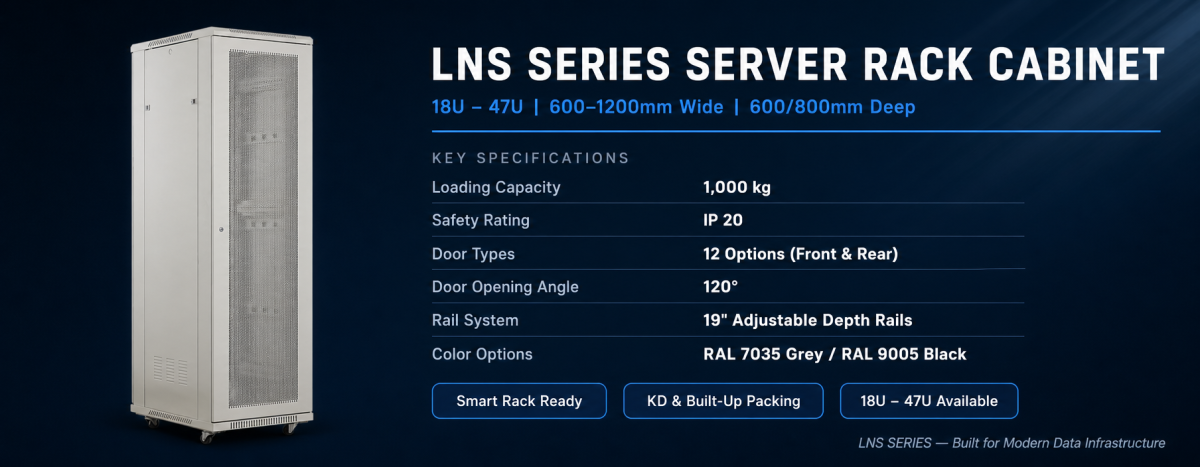
Across all sizes — from the 18u cabinet to the 47u cabinet — the following specifications remain constant in the LNS Series: IP 20 safety rating, 1,000 kg maximum load capacity, 19-inch front and rear profile rails (depth adjustable with U markings), 12 door type options for front and rear, 120-degree door opening angle, reversible door stop, quick-release lockable side panels (optional metal lock), RAL 7035 grey or RAL 9005 black finish, grounding wire included, and a standard accessory package of heavy-duty castors, leveling feet, and 25 cage nuts.
Width and Depth Configuration: Optimising for Your Equipment
Beyond U height, the LNS Series offers an industry-leading range of width and depth options that allow each cabinet to be precisely matched to its equipment and physical installation environment.
Width Options: 600mm to 1200mm
LNS Series cabinets are available in five widths: 600mm, 800mm, 1000mm, 1100mm, and 1200mm. The 600mm width is the minimum required to accommodate standard 19-inch rack equipment and is typically chosen where space efficiency is the overriding priority. The 800mm width is the most popular choice: it provides additional side clearance for cable routing and, in the case of the LNS 800mm cabinets, includes two vertical cable managers as a standard inclusion. Wider options — 1000mm, 1100mm, and 1200mm — are specified for environments requiring enhanced side cable management, wider equipment clearances, or structural reinforcement for particularly heavy or wide rack-mounted systems.
For deployments involving a 42u cabinet or 47u cabinet in a multi-rack row, the 800mm width is typically the optimal balance between cable management convenience and floor space efficiency. For smaller enclosures such as the 18u cabinet or 22u cabinet, the 600mm width is frequently sufficient, particularly in environments where the cabinet will be placed against a wall or in a dedicated equipment closet.
Depth Options: 600mm and 800mm
LNS Series cabinets are available in 600mm and 800mm depths. The 600mm depth accommodates the majority of networking equipment — switches, patch panels, firewalls, and 1U servers — and is the standard choice for network-focused deployments and smaller enclosures such as the 18u cabinet, 22u cabinet, and 27u cabinet. The 800mm depth is specified for environments where deep-mounted equipment — including full-depth servers, dual-port storage arrays, and high-density blade chassis — requires additional rail clearance. For the 37u cabinet, 42u cabinet, and 47u cabinet in high-density data center configurations, the 800mm depth is the preferred specification, as it accommodates the widest possible range of enterprise server hardware.
Smart Rack Capabilities: Transforming Every LNS Cabinet
One of the most strategically important features of the LNS Series is its native compatibility with a comprehensive smart rack ecosystem. Every LNS enclosure — from the 18u cabinet deployed in a remote edge location to the 47u cabinet in a high-density data center row — can be transformed into an intelligent, remotely managed infrastructure node by adding any combination of the following smart components:
- Smart PDU: Remotely monitored and individually switched power distribution, providing outlet-level power metering and control for every device in the rack.
- Smart Lock: Electronically controlled access management with audit logging, supporting role-based authentication and real-time alerts on unauthorised access attempts.
- Front Door LED Screen: Real-time status display for rack-level and infrastructure-level metrics, accessible without opening the cabinet door.
- Integrated Smart System: A unified management platform that consolidates PDU, lock, environmental monitoring, and asset tracking data into a single dashboard.
For organisations managing geographically distributed infrastructure, the smart rack capability of the LNS Series is particularly valuable. A 27u cabinet or 32u cabinet at a branch office location can be remotely monitored and managed with the same tools and dashboards as a 42u cabinet or 47u cabinet in the central data center, creating a consistent operational model across the entire infrastructure estate regardless of cabinet size.
Packaging and Logistics: Flat Pack and Assembly Options
The LNS Series offers two packaging methods, both of which are available across all U heights from the 18u cabinet to the 47u cabinet:
- Flat Pack (Knock Down / KD): The cabinet is disassembled into its component panels and frames, packaged flat, and shipped on a pallet. This method maximises container utilisation and minimises freight cost per unit — a key advantage for international buyers ordering multiple cabinets, particularly when shipping larger enclosures such as the 37u cabinet, 42u cabinet, or 47u cabinetin container loads.
- Assembly Pack (Build-Up): The cabinet is fully assembled and shipped on a pallet, ready for immediate installation on arrival. This method minimises on-site labour requirements and is preferred for single-unit deliveries or deployments where assembly capacity at the destination is limited.
The choice between flat pack and assembly pack should be evaluated in the context of total landed cost. For high-volume orders of the 42u cabinet or 47u cabinet destined for international colocation deployments, flat pack packaging can reduce freight costs by 30–50 percent compared to assembled shipping. For smaller orders of the 18u cabinet or 22u cabinet, the time and labour cost of on-site assembly may outweigh the freight savings of flat pack packaging, making the assembly option the more practical choice.
Use Cases by Deployment Environment
Data Center Construction
For new data center construction projects, the 42u cabinet and 47u cabinet are the standard specification choices, offering the highest equipment density and the most comprehensive accessory ecosystem. Multi-row deployments typically combine multiple 42u cabinet or 47u cabinet enclosures in hot-aisle/cold-aisle arrangements, with common overhead cable management and shared power distribution infrastructure. The LNS Series’ consistent accessory ecosystem and door-type flexibility make it an ideal platform for data center operators who need to standardise on a single enclosure family across hundreds or thousands of racks.
SOHO and Small Business Offices
For SOHO and small business deployments, the 18u cabinet and 22u cabinet are the most frequently specified enclosures. Their compact physical footprint, professional aesthetic (available in both grey and black), and full compatibility with the LNS accessory ecosystem make them an ideal fit for equipment closets, server alcoves, and open-plan office environments. The 27u cabinet is also popular in this segment for businesses that anticipate growth or require additional equipment space for audio/visual systems, access control panels, or building management systems alongside IT equipment.
Educational Institutions
Schools, colleges, and universities typically deploy LNS Series cabinets across a wide range of U heights depending on the specific installation. Campus data centers and IT centralisation projects commonly use the 42u cabinet or 47u cabinet for core infrastructure, while individual buildings, classrooms, and IT closets are served by 18u cabinet, 22u cabinet, or 27u cabinet installations. The LNS Series’ robust construction and IP 20 rating ensure reliable performance in educational environments where equipment is accessed frequently and maintenance resources may be limited.
Healthcare and Medical Facilities
Healthcare IT environments place exceptional demands on server rack reliability, security, and cable management quality. The LNS Series 27u cabinet and 32u cabinet are popular choices for clinical department IT rooms, where a diverse mix of servers, medical imaging storage, network switches, and compliance-mandated logging systems must be accommodated within a single, secure enclosure. For hospital data centers and regional health information exchanges, the 42u cabinet and 47u cabinet provide the density required for centralised clinical data management and electronic health record systems.
Telecommunications and Building Infrastructure
Telecommunications operators and building infrastructure providers routinely specify the LNS 37u cabinet, 42u cabinet, and 47u cabinet for central office equipment rooms, point-of-presence (POP) nodes, and in-building telecommunications installations. The LNS Series’ compliance with standard 19-inch rack dimensions, its compatibility with a wide range of telecom-grade accessories, and its availability in both flat pack and assembly packaging make it a practical and cost-effective platform for telecom infrastructure at every scale.
How to Order: Configuration Checklist
Ordering an LNS Series cabinet — whether an 18u cabinet, a 32u cabinet, or a 47u cabinet — requires confirming a defined set of configuration parameters. Using the following checklist ensures that your order datasheet captures every required specification and eliminates the risk of post-delivery configuration discrepancies.
- U Height (Capacity): Specify the required rack unit count — 18U, 22U, 27U, 32U, 37U, 42U, or 47U — based on your current equipment inventory and anticipated growth.
- Width: Select from 600mm, 800mm, 1000mm, 1100mm, or 1200mm based on equipment clearance and cable management requirements.
- Depth: Choose 600mm (standard network equipment) or 800mm (deep-mounted servers and storage).
- Front Door Type: Select from twelve available types (perforated, solid, glazed, vented, mesh, etc.) based on security and airflow requirements.
- Rear Door Type: Select from twelve available types — front and rear doors can be specified independently.
- Door Lock Type: Specify the lock type for both front and rear doors.
- Side Panel Lock: Choose between standard quick-release (no lock), quick-release with round metal lock, or no side panels.
- Colour: RAL 7035 light grey or RAL 9005 black.
- Cable Management: Horizontal cable managers (specify U positions), vertical cable managers (standard in 800mm wide models), or both.
- Smart Accessories: Smart PDU, smart lock, front door LED screen — specify if required.
- Packaging Method: Flat Pack (Knock Down) or Assembly Pack (Build-Up) with pallet.
- Grounding Wire: Included as standard; confirm if additional grounding accessories are required.
- Additional Accessories: Brush cable entries, additional cage nuts, shelf units, blanking panels.
For multi-unit orders — for example, a mixed deployment of 32u cabinet and 42u cabinet enclosures — it is strongly recommended to submit a consolidated order datasheet that specifies the configuration of each individual cabinet, clearly differentiating between units of different U heights, widths, depths, and door configurations. This ensures accurate production scheduling and eliminates the risk of receiving incorrectly configured enclosures in a time-sensitive installation project.
Frequently Asked Questions
Q: Can I mix different U heights in the same data center row?
A: Yes. The LNS Series maintains consistent exterior design language and accessory compatibility across all U heights. An 18u cabinet, 27u cabinet, 32u cabinet, 42u cabinet, and 47u cabinet can all be deployed in the same row, sharing common power distribution and cable management infrastructure, provided that the widths are matched appropriately.
Q: Is the 1,000 kg load rating consistent across all U heights?
A: Yes. The 1,000 kg maximum load capacity applies to every LNS Series enclosure, from the 18u cabinet to the 47u cabinet. This capacity is achieved through the combination of premium-grade steel, precision manufacturing techniques, and a robust frame design that distributes load evenly across all structural elements.
Q: What is the lead time for LNS Series cabinets?
A: Standard lead times vary based on U height, configuration complexity, and order volume. Stock configurations of the 18u cabinet, 22u cabinet, 42u cabinet, and 47u cabinet are typically available with shorter lead times. Custom colour, non-standard door types, or large-volume orders of the 27u cabinet, 32u cabinet, or 37u cabinet may require additional production lead time. Contact our sales team for a project-specific lead time estimate.
Q: Can LNS cabinets be upgraded to smart rack configurations after initial deployment?
A: Yes. The LNS Series is designed to support smart rack accessory integration at any point in the cabinet’s lifecycle. An 18u cabinet or 42u cabinet that was initially deployed in a standard configuration can be upgraded with a smart PDU, smart lock, or front-door LED screen without modification to the base enclosure.
Q: Which packaging method is recommended for international shipping?
A: For international freight, flat pack (Knock Down) packaging is strongly recommended for all U heights, particularly for the 37u cabinet, 42u cabinet, and 47u cabinet, where the assembled dimensions would significantly increase shipping volume and cost. Assembly packaging is typically more appropriate for domestic deliveries or single-unit orders where on-site assembly resources are limited.
Conclusion: Selecting the Right LNS Cabinet for Your Infrastructure
The LNS Series server rack family offers a compelling, coherent solution for IT infrastructure deployment at every scale. Whether your project calls for an 18u cabinet in a compact office environment, a 27u cabinet for a growing SMB, a 37u cabinet in a regional data hub, the industry-standard 42u cabinet for an enterprise data center, or the high-density 47u cabinet for maximum rack utilisation, the LNS Series delivers consistent engineering quality, industry-leading load capacity, and a rich configuration ecosystem that adapts to your specific requirements.
The key to a successful deployment is matching the correct U height to your current and anticipated equipment inventory, selecting the appropriate width and depth for your installation environment, and configuring the door types, lock options, and cable management system that align with your security and operational requirements. By following the guidance in this article and using the configuration checklist provided, you can ensure that every LNS cabinet you deploy — from the 22u cabinet in your remote office to the 47u cabinet in your primary data center — delivers the performance, reliability, and scalability that your infrastructure demands.
For organisations at the planning stage, we recommend beginning with a detailed equipment audit and a five-year growth forecast before specifying U heights. If the audit confirms that an 18u cabinet or 22u cabinet meets your current needs but growth projections suggest you will exceed capacity within two years, the modest incremental investment of stepping up to a 27u cabinet or 32u cabinet at the outset will deliver significantly greater long-term value. Similarly, for data center projects where density is a primary design criterion, the additional five rack units of the 47u cabinet over the 42u cabinet can represent a meaningful improvement in rack utilisation efficiency and total infrastructure cost.
Contact our team today to discuss your specific deployment requirements, request a customised order datasheet, or obtain pricing for any configuration of the LNS Series — from the 18u cabinet to the 47u cabinet.