When it comes to building or upgrading a data center, server room, or enterprise network infrastructure, few decisions carry as much long-term weight as choosing the right 42U rack. As the industry-standard form factor that has dominated IT environments for decades, the 42U rack provides the ideal balance of equipment capacity, accessibility, and space efficiency that data center operators and IT managers have come to rely on.
A 42U rack stands approximately 78.7 inches (2000mm) tall, providing 42 rack units (1U = 1.75 inches) of vertical mounting space. This height is not arbitrary—it has been refined over years of practical deployment experience to maximize the amount of equipment that can be housed in a single enclosure while remaining accessible to technicians without requiring ladders or specialized lifting equipment for routine maintenance tasks. A properly specified 42U rack can accommodate dozens of servers, switches, storage arrays, and power distribution units in an organized, secure, and thermally managed environment.
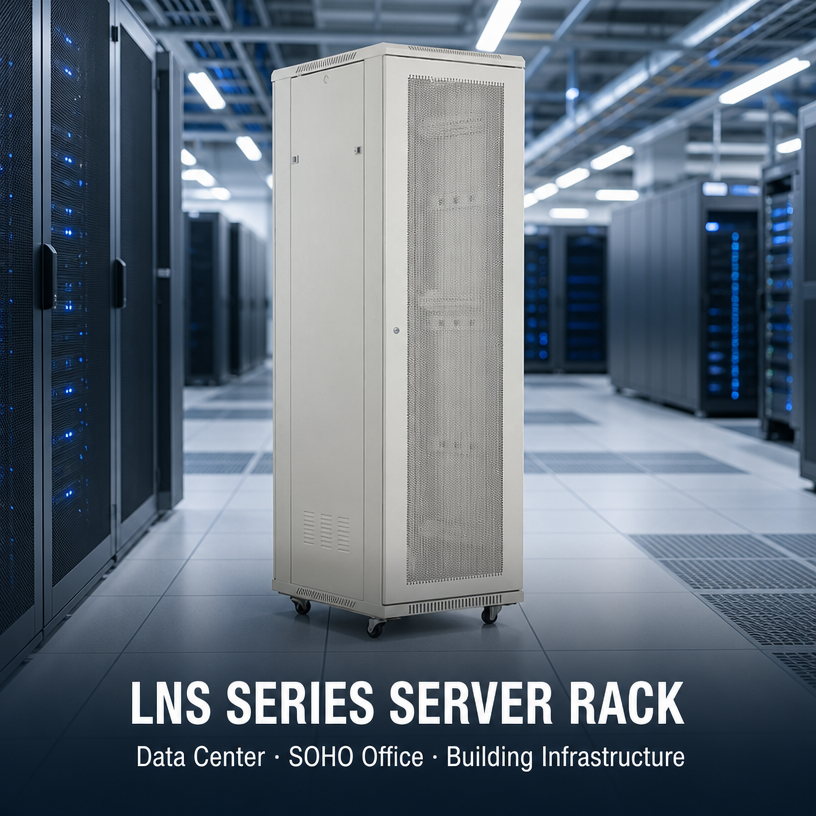
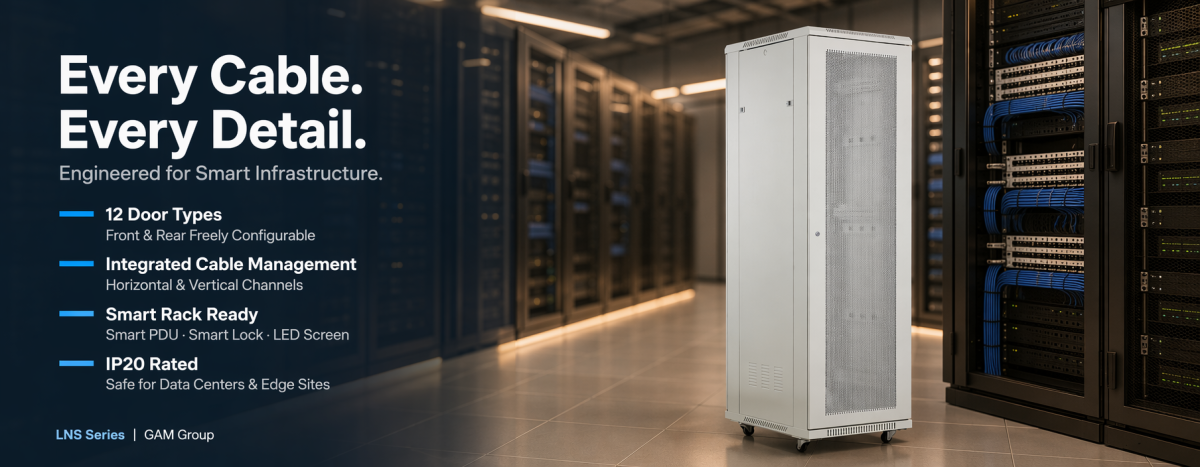
However, not all 42U racks are created equal. Differences in frame rigidity, load capacity, cable management features, door configurations, and smart capabilities can have a profound impact on operational efficiency, equipment reliability, and total cost of ownership over the service life of the rack. This comprehensive guide will walk you through everything you need to know about selecting, configuring, and deploying a 42U rack that meets the demands of modern IT infrastructure—with a detailed look at the LNS Series 42U rack from GAM Group, one of the most popular and versatile 42U rack solutions available in the global market today.
 Why the 42U Rack Became the Industry Standard
The dominance of the 42U rack in data centers worldwide is not an accident of history. It is the result of decades of practical experience, standards evolution, and optimization across thousands of real-world deployments. Understanding why the 42U rack became the default choice helps explain why it remains the smartest starting point for most IT infrastructure projects today.
The 19-inch rack mounting standard was originally developed by the telecommunications industry and later adopted by the computing industry as servers transitioned from proprietary cabinet designs to standardized rack-mountable form factors. Over time, the 42U rack emerged as the sweet spot: tall enough to house a substantial amount of equipment in a single footprint, yet not so tall that the topmost units become difficult to reach. In a typical data center with raised flooring, a 42U rack allows the average adult technician to access all rack units from floor level without a step stool for most operations, while still leaving room for overhead cable trays and cooling infrastructure above the rack.
From a real estate perspective, a 42U rack also represents an efficient use of data center floor space. Data center floor tiles are typically 600mm x 600mm (approximately 24 inches square), and a standard 42U rack with a 600mm or 800mm width fits neatly within one or two tiles. This alignment simplifies the layout of hot and cold aisles, perforated floor tiles for under-floor cooling, and overhead cable ladder pathways. When planning a new facility, standardizing on the 42U rack form factor eliminates many of the layout complexities that arise when mixing racks of different heights and footprints.
Today, the 42U rack is the default specification for server cabinets, network cabinets, and colocation cages in data centers on every continent. From hyperscale cloud facilities to single-rack enterprise server rooms, the 42U rack provides a consistent, predictable platform that supports equipment from every major hardware vendor and is understood by every IT professional who walks through the door.
Key Features to Look for in a 42U Rack
When evaluating a 42U rack for your deployment, there are several critical characteristics that separate a professional-grade enclosure from a commodity product. The LNS Series 42U rack from GAM Group exemplifies the features that matter most in real-world IT operations. Here are the essential attributes to prioritize.
1. Structural Integrity and Frame Rigidity
The frame is the skeleton of any 42U rack, and its quality determines how well the rack performs over years—and often decades—of service. A 42U rack that flexes, twists, or develops alignment issues over time will cause cascading problems: equipment rails no longer align, servers become difficult to slide in and out, and grounding continuity can be compromised.
The LNS Series 42U rack is manufactured using branded raw material steel and advanced production techniques that deliver exceptionally high frame rigidity. This means the 42U rack maintains its structural integrity even when fully loaded with heavy servers, storage arrays, and UPS systems. The frame is engineered to support an impressive 1000 kg static loading capacity—substantially more than the typical 500-800 kg rating found on economy-grade 42U racks. For IT managers, this higher load rating provides a significant safety margin and the flexibility to deploy heavier equipment configurations without concern.
The 19-inch profile rails in the LNS Series 42U rack are mounted in both the front and rear of the cabinet. This dual-rail architecture distributes equipment weight evenly and prevents the rail sag that can occur in 42U racks with single-sided mounting. Each rail is depth-adjustable, allowing technicians to reposition the mounting plane to accommodate equipment of varying depths—from shallow 1U switches and patch panels to deep 4U storage servers with extended chassis. Clear unit-marking (U-marking) on the rails of the 42U rack makes equipment positioning fast and error-free, a detail that anyone who has miscounted rack units during a late-night maintenance window will deeply appreciate.
2. Load Capacity and Heavy-Duty Construction
Modern IT equipment is heavier than ever. A single 4U GPU server can weigh over 40 kg. A fully populated 42U rack with a mix of servers, storage, network switches, and power distribution can easily exceed 600-800 kg. This is why the 1000 kg loading capacity of the LNS Series 42U rack is not just a marketing number—it is a genuine engineering requirement for deployments that push the limits of rack density.
The LNS Series 42U rack comes standard with heavy-duty castor wheels and adjustable leveling feet. During the installation phase, the castors allow a single technician to maneuver a 42U rack into its final position—no small feat given that even an empty 42U rack of this construction quality weighs significantly more than a budget alternative. Once positioned, the leveling feet are extended to lift the castors off the floor, providing a stable, vibration-free platform for sensitive equipment. This is particularly important in seismic zones or environments with floor vibration from nearby mechanical equipment, where a 42U rack must remain absolutely stable to prevent cumulative stress on server hard drives and internal components.
Each LNS Series 42U rack also includes 25 sets of cage nuts as standard equipment. Cage nuts are the small threaded inserts that clip into the square holes of the 19-inch rails and provide the mounting points for equipment screws. Having a generous supply of cage nuts included with every 42U rack eliminates the frustration of running out of mounting hardware mid-installation—a common pain point that many IT technicians have learned to dread with racks from less thoughtful manufacturers.
3. Flexible Door and Access Configurations
Accessibility, security, and airflow requirements vary dramatically between deployment environments. A 42U rack in a hyperscale data center may need maximum-open-area perforated doors for unimpeded cooling airflow, while a 42U rack in a corporate server room may benefit from a tempered glass front door that presents a clean, professional appearance to visiting stakeholders. A colocation 42U rack may require fully solid steel doors with advanced locking mechanisms to satisfy tenant security requirements.
The LNS Series 42U rack addresses this diversity with 12 different front and rear door types that can be freely selected and combined. This level of customization means that every 42U rack can be tailored to its specific deployment context without compromise. All door options feature a 120-degree opening angle, providing generous interior access for equipment installation and cable management tasks. The door stop mechanism is easily field-reversible from left to right, allowing the 42U rack to be placed against a wall on either side without sacrificing door functionality—a practical advantage in space-constrained server rooms where every inch of clearance matters.
The side panels of the LNS Series 42U rack utilize a plastic quick-release lockable mechanism for fast access during maintenance while preventing unauthorized entry. For higher-security deployments, a round metal lock option is available. This layered approach to access control ensures that the 42U rack can be configured for environments ranging from open-plan office IT closets to multi-tenant colocation facilities with strict physical security requirements.
4. Advanced Cable Management for a 42U Rack
A 42U rack without proper cable management quickly becomes a nightmare of tangled power cords, Ethernet cables, and fiber optic patch leads. Poor cable organization obstructs airflow, increases the time required for troubleshooting and equipment swaps, and creates trip hazards around the rack. In a high-density 42U rack with hundreds of connections, cable management is not optional—it is essential infrastructure.
The LNS Series 42U rack incorporates comprehensive cable management features at every level. Large cable entry points with black cellular grommets are located at the top and bottom of the rack, providing organized pathways for structured cabling entering and exiting the enclosure. These grommets protect cables from sharp metal edges while maintaining a clean, professional appearance. For installations that require cable routing at non-standard locations—such as overhead fiber trays or under-floor power distribution—optional brush cable entry panels can be installed anywhere on the 42U rack, offering complete flexibility for unique facility layouts.
Inside the 42U rack, both horizontal and vertical cable management options are available. Horizontal cable managers keep patch cords organized at each rack unit level between switches and patch panels, while vertical cable managers handle the larger bundles of structured cabling that run from top to bottom. The 800mm-wide version of the LNS Series 42U rack includes two vertical cable managers as standard equipment—an inclusion that competitors often treat as a paid optional accessory. For high-port-density 42U rack deployments where hundreds of cables converge, this standard inclusion delivers immediate value and a cleaner installation.
5. Ventilation, Cooling, and Environmental Management
Thermal management is one of the greatest challenges in modern 42U rack deployments. High-performance servers, GPU clusters, and converged infrastructure systems generate substantial heat, and a 42U rack must be designed to facilitate efficient front-to-back airflow that aligns with the cooling architecture of the equipment it houses.
The LNS Series 42U rack carries an IP20 safety rating, indicating protection against solid objects larger than 12.5mm—adequate for preventing accidental contact with internal components while maintaining sufficient openness for natural convection cooling. The perforated door options available for the LNS Series 42U rack provide large open areas for air intake at the front and exhaust at the rear, establishing a natural airflow path that matches the cooling design of virtually all rack-mounted servers and networking equipment.
The top and bottom cable entry points in the 42U rack also contribute to chimney-effect airflow that helps dissipate heat from the upper rack units—where temperatures naturally run highest. For deployments requiring active cooling supplementation, the depth-adjustable rails and spacious interior dimensions of the LNS Series 42U rack provide ample clearance for installing rack-mounted fan trays, rear-door heat exchangers, or in-row cooling solutions. The wider 800mm to 1200mm variants of the 42U rack offer additional side clearance for vertical airflow channels, which is critical for maintaining cooling effectiveness in high-density deployments where every degree of temperature rise impacts equipment reliability.
6. Security Features and Access Control
Physical security for a 42U rack is a multi-layered concern that extends beyond simply locking the front door. In shared data centers, colocation facilities, and enterprise environments, multiple levels of access control are required to protect sensitive equipment and meet compliance requirements.
The LNS Series 42U rack provides security at every access point. Lockable front and rear doors with selectable lock types form the primary barrier against unauthorized entry. Lockable side panels prevent access to equipment from adjacent rack positions—an important consideration in colocation environments where a 42U rack may be positioned directly next to another tenant’s rack. Grounding wires are included as standard equipment, ensuring proper electrical continuity across all metal components of the 42U rack. Warning and information stickers applied to the front and rear bottom frame provide permanent safety labeling directly on the equipment.
For advanced security requirements, the LNS Series 42U rack can be configured as a smart rack cabinet with electronic access control. A smart lock system enables audit trails of every door access event, remote locking and unlocking via management software, and integration with building access control systems. When combined with environmental sensors, a smart 42U rack provides facility managers with complete visibility into who accesses the rack and when —a capability that is increasingly mandatory for organizations subject to regulations such as SOC 2, HIPAA, PCI DSS, and ISO 27001.
7. Smart 42U Rack Capabilities and DCIM Integration
Data Center Infrastructure Management (DCIM) has become a standard practice in enterprise IT environments, and the 42U rack is increasingly expected to participate as an intelligent node in the broader facility management ecosystem. The LNS Series 42U rack was designed with this evolution in mind and supports a comprehensive smart upgrade path.
The smart configuration of the LNS Series 42U rack includes integration with a smart PDU that provides per-outlet power monitoring, remote switching capability, and energy consumption analytics. A front-door LED screen can display real-time environmental data—including internal temperature, humidity, and power load—giving data center technicians at-a-glance situational awareness without needing to access a management console. This is particularly valuable in large facilities where technicians may be walking rows of 42U racks and can quickly identify thermal or power anomalies by glancing at the LED displays.
The value of a smart 42U rack extends beyond day-to-day convenience. Environmental monitoring can alert facility teams to cooling failures before equipment damage occurs, potentially preventing millions of dollars in hardware loss and downtime. Power monitoring enables precise capacity planning and helps identify underutilized circuits that can be consolidated. Access logs support compliance audits and forensic investigations. By choosing a 42U rack platform that supports these smart capabilities, organizations can deploy basic configurations today and incrementally add intelligence as their DCIM maturity and budget evolve over time.
How to Specify the Right 42U Rack for Your Deployment
With the extensive configuration options available for the LNS Series 42U rack, selecting the optimal specification requires careful consideration of your specific deployment context. The following decision framework will help you narrow down the options and ensure that every 42U rack you order matches your exact requirements.
Step 1: Confirm the Rack Unit Count
While this guide focuses on the 42U rack as the industry-standard form factor, it is worth confirming that 42U is indeed the right height for your needs. The LNS Series is also available in heights from 18U to 60U. A 42U rack provides 42 rack units of vertical mounting space. To confirm that a 42U rack is appropriate:
- Inventory all equipment planned for the 42U rackand note the U-height of each device.
- Sum the total U-space required and add at least 25-30% spare capacity for future expansion within the 42U rack.
- Account for horizontal cable managers, horizontal PDUs, blanking panels, and any other accessories that consume rack units.
- If the total exceeds approximately 32U of planned equipment, a 42U rackis the correct choice, providing room for growth. If below 20U, consider a smaller form factor.
Step 2: Choose the Right Width
The LNS Series 42U rack is available in widths of 600mm, 800mm, 1000mm, 1100mm, and 1200mm. The width of your 42U rack should be selected based on cabling density, airflow requirements, and the physical constraints of your facility:
- 600mm width: The standard 19-inch equipment width. Suitable for most networking-focused 42U rackdeployments where switch and patch panel density is moderate. The most cost-effective and space-efficient option.
- 800mm width: Provides generous side clearance for vertical cable managers (two included as standard in the LNS Series 42U rack). The recommended width for 42U racks with high port-density switching or extensive structured cabling.
- 1000mm to 1200mm width: Wide-body 42U rackconfigurations designed for high-density server deployments with large cable bundles, side airflow channels, or equipment with extended-width mounting brackets. The 1200mm 42U rack offers maximum internal working volume.
Step 3: Select the Depth
Depth options for the LNS Series 42U rack are 600mm and 800mm. The choice depends on the deepest piece of equipment planned for the 42U rack, plus allowances for power cords, cable management arms, and rear door clearance:
- 600mm depth: Suitable for network switches, patch panels, shallow-depth servers, and wall-mount-adjacent 42U rackinstallations where floor space is constrained.
- 800mm depth: The recommended depth for standard servers, storage arrays, and enterprise IT equipment. An 800mm-deep 42U rackprovides necessary clearance for server cable management arms and rear cabling without forcing dangerously tight bend radii on power cords or fiber connections.
When calculating the required depth for a 42U rack, always add at least 100mm beyond the chassis depth of the deepest equipment to account for power cord protrusion, cable management arms, and airflow clearance. A 42U rack that is too shallow will prevent the rear door from closing or force cables into tight bends that can cause premature failure or signal degradation in high-speed network connections.
Step 4: Configure Doors, Locks, and Color
With 12 door types, multiple lock configurations, and two professional finish colors (RAL7035 light grey and RAL9005 black), the LNS Series 42U rack can be tailored to any deployment aesthetic and functional requirement:
- High-density data center: Perforated front and rear doors for maximum airflow. Standard keyed locks. RAL9005 black or RAL7035 light grey to match existing rack rows.
- Corporate server room: Tempered glass front door for professional appearance, solid or perforated rear door. RAL7035 light grey for a clean, modern look.
- Colocation facility: Configure each 42U rackto the specific tenant requirements—mesh doors, solid doors, or a mix—with appropriate lock types and security levels.
- Edge / non-data-center deployment: Fully solid doors with enhanced locks for environments where physical security and dust protection take priority over maximum airflow in the 42U rack.
Step 5: Choose the Packaging and Shipping Method
The LNS Series 42U rack offers two shipping formats. Flat packing (knock-down) ships the 42U rack as a disassembled kit, reducing shipping volume and cost—this is ideal for large orders or projects where on-site assembly labor is available. Assembly packing (built-up) delivers the 42U rack fully assembled on a pallet, ready for immediate deployment—this is preferred for smaller orders or urgent deployments where minimizing on-site labor time is the priority.
When placing an order for an LNS Series 42U rack, the ordering datasheet must clearly specify: front and rear door types, door lock type, side panel lock preference, color, depth, width, height (42U), and transportation packing method. Providing this complete specification ensures that every 42U rack arriving on site matches the exact requirements for its intended deployment position.
Common Deployment Scenarios for a 42U Rack
The versatility of the 42U rack form factor makes it the default choice across a wide range of deployment scenarios. Here are the environments where the LNS Series 42U rack delivers the most value:
Data Center New Builds and Expansions
Greenfield data center construction and brownfield capacity expansion projects represent the largest deployment category for the 42U rack. In these environments, standardizing on a single 42U rack platform across hundreds or thousands of rack positions simplifies every aspect of the project: procurement and logistics, physical installation, commissioning and testing, and ongoing maintenance. The LNS Series 42U rack, with its 1000 kg load capacity, 12 door types, and smart upgrade path, provides data center operators with a single SKU that can serve every rack position while being individually configured for specific deployment requirements—from basic server racks to high-security colocation cages.
Enterprise Server Rooms and On-Premises Infrastructure
For organizations that maintain on-premises IT infrastructure, the 42U rack provides a professional, organized housing for servers, storage, networking, and power distribution. A 42U rack with a tempered glass front door in RAL7035 light grey presents a clean, credible image to executives and auditors who may tour the facility. Behind that professional facade, the practical features—depth-adjustable rails, integrated cable management, generous load capacity—enable the IT team to work efficiently and maintain equipment according to best practices.
Colocation and Multi-Tenant Data Centers
Colocation facilities present unique requirements for the 42U rack. Each tenant may have different security, access, and configuration needs for their 42U rack footprint. The LNS Series 42U rack with its 12 door options, multiple lock types, and metal side panel lock upgrade allows colocation operators to offer differentiated cabinet profiles to different customer tiers. A single colocation suite might contain basic mesh-door 42U racks for cost-sensitive tenants alongside high-security, smart-lock-enabled 42U racks for financial services or healthcare tenants with strict compliance requirements—all from the same product platform.
Edge Computing and Distributed IT
As edge computing deployments grow, the 42U rack is increasingly deployed outside traditional data center environments. Manufacturing facilities, logistics warehouses, retail distribution centers, and remote offices all require a 42U rack that can withstand less-controlled environmental conditions while protecting critical IT equipment. The robust steel construction, IP20 rating, and configurable door and lock options of the LNS Series 42U rack make it a dependable choice for edge deployments where on-site technical support may be limited and physical security requirements may be elevated.
Best Practices for 42U Rack Installation and Maintenance
Once you have specified and received your LNS Series 42U rack, following proven installation and maintenance practices will maximize the value and service life of your investment. Here are recommendations drawn from real-world data center operations experience:
- Plan the equipment layout before mounting. Arrange heavier devices (UPS units, storage arrays, large servers) in the lower portion of the 42U rackfor stability and easier handling. Lighter networking equipment can occupy the upper rack units.
- Use blanking panels to cover every unused rack unit. Open gaps in a 42U rackdisrupt the intended front-to-back airflow pattern and cause hot exhaust air to recirculate to equipment intakes. Blanking panels are one of the most cost-effective cooling improvements you can make.
- Implement a clear labeling system for every cable, patch panel port, and piece of equipment in the 42U rack. Color-coded labels for different network zones or functions dramatically reduce troubleshooting time and eliminate guesswork during maintenance windows.
- Verify that the grounding wires included with the LNS Series 42U rackare properly connected to facility ground. All mounted equipment should be bonded to the rack grounding system. In a 42U rack with dozens of devices, a single grounding fault can create unpredictable and hard-to-diagnose equipment issues.
- Schedule periodic inspections of the 42U rack: check cage nut tightness, door hinge and lock operation, cable grommet integrity, and general cleanliness. A well-maintained 42U rackwill deliver decades of reliable service.
- Keep the interior of the 42U rack Dust accumulation acts as thermal insulation on heat-generating components and can, in extreme cases, create electrical issues. Depending on the deployment environment, plan for quarterly or semi-annual cleaning.
- Document the equipment layout of each 42U rack. Maintain an up-to-date rack elevation diagram that shows the exact position of every device. This documentation is invaluable for capacity planning, troubleshooting, and onboarding new team members.
Why the LNS Series 42U Rack Delivers Superior Value
The global market for 42U racks spans a wide range from budget commodity products to premium custom-engineered enclosures. The LNS Series 42U rack occupies a strategic middle ground that combines the cost-effectiveness of a standardized product line with the quality, rigidity, and configurability that serious IT professionals demand.
Several factors distinguish the LNS Series 42U rack in a competitive market. The branded raw material steel and advanced manufacturing processes deliver frame rigidity that exceeds economy-grade alternatives—this is a 42U rack built to maintain its structural integrity through years of equipment changes and reconfigurations. The 1000 kg load capacity provides a genuine safety margin for high-density deployments, allowing IT managers to deploy heavier equipment with confidence. The 12 door types, five width options, two depth options, and extensive accessory ecosystem mean that the LNS Series 42U rack can be precisely configured for any deployment scenario without resorting to costly custom fabrication.
Perhaps most importantly, the standard inclusion of items that competitors treat as optional extras—heavy-duty castors, leveling feet, 25 sets of cage nuts, grounding wires, warning stickers, and (for 800mm-wide models) two vertical cable managers—represents genuine value in a 42U rack purchase. When comparing prices, it is essential to build a complete, apples-to-apples specification and compare total delivered cost rather than base unit price alone. The LNS Series 42U rack consistently proves competitive on this total-cost basis while delivering quality that exceeds what the price point would suggest.
The smart upgrade path is the final differentiator. A 42U rack purchased today can be retrofitted tomorrow with a smart PDU, smart lock, LED screen, and environmental monitoring sensors. This protects the initial investment and allows organizations to adopt DCIM capabilities on their own schedule and budget, rather than being forced into a forklift upgrade when operational requirements evolve.
Conclusion: The 42U Rack as the Foundation of Reliable IT Infrastructure
A 42U rack is one of the longest-serving components in any IT environment. Servers are refreshed every three to five years. Switches are upgraded as bandwidth demands grow. Storage arrays are expanded or replaced. But the 42U rack itself—if chosen wisely—remains in service for a decade or more, quietly doing its job of protecting, organizing, cooling, and securing the equipment that powers modern business.
The LNS Series 42U rack from GAM Group has earned its position as one of the most popular 42U rack lines in the global market by delivering exactly what IT professionals need: a rigid, high-capacity, extensively configurable enclosure that is cost-effective without cutting corners on the features that matter. With 1000 kg load capacity, 12 door types, flexible width (600mm to 1200mm) and depth (600mm and 800mm) options, depth-adjustable 19-inch rails, comprehensive cable management, IP20-rated construction, and a smart upgrade path to full DCIM integration, this 42U rack is engineered to serve as the reliable physical foundation for your IT infrastructure through multiple generations of equipment refreshes.
Whether you are building out a new data center, expanding an existing facility, upgrading an enterprise server room, deploying edge computing infrastructure, or equipping a colocation cage, the LNS Series 42U rack deserves serious consideration. Its combination of quality, flexibility, and value makes it a compelling choice for IT managers, data center operators, and facility engineers who understand that the right 42U rack is not an expense—it is the essential infrastructure that enables everything built on top of it.
To discuss your 42U rack requirements and receive a tailored configuration recommendation based on your specific deployment scenario, contact GAM Group today. With the LNS Series 42U rack, you are investing in a platform that will support your IT operations reliably and securely for years to come.