When it comes to organizing, protecting, and scaling your IT infrastructure, few decisions carry more long-term impact than selecting the right 19 inch network cabinet. Whether you are managing a corporate data center, a server room in a mid-sized business, or a growing telecom deployment, the enclosure you choose directly affects airflow, cable management, security, and the overall reliability of your network.
A 19 inch network cabinet is not simply a metal box. It is the backbone of your entire rack system — the structure that holds servers, switches, patch panels, PDUs, and cable management hardware in a precisely engineered environment. Getting this choice right from the start saves thousands of dollars in downtime, re-cabling costs, and equipment replacements.
This comprehensive guide walks you through everything you need to know about the 19 inch network cabinet what it is, how the key specifications affect your installation, what features matter most, and how the LNH Series — a professional-grade line of network enclosures — delivers on every dimension that matters to modern IT and telecom teams.
 What Is a 19 Inch Network Cabinet and Why Does It Matter?
The term ’19 inch’ refers to the standardized width of the mounting rails inside a rack enclosure, originally defined by the Electronic Industries Alliance (EIA). This 19-inch rail standard allows equipment from virtually any manufacturer — switches, servers, UPS units, fiber panels — to mount securely inside the same 19 inch network cabinet. This universality has made the 19-inch form factor the global default for professional IT deployments for more than four decades.
What separates a professional-grade 19 inch network cabinet from a generic enclosure is the engineering behind the details: the rigidity of the frame, the precision of the rail positioning, the quality of the door locks, and the sophistication of the ventilation design. When you invest in a properly engineered 19 inch network cabinet, you are investing in a platform that will support your infrastructure for 10 to 20 years.
The global data center market continues to expand rapidly, driven by cloud computing, edge deployments, 5G rollouts, and enterprise digital transformation. In each of these environments, the 19 inch network cabinet remains the foundational building block. Understanding how to evaluate them is essential for any IT manager, network engineer, or procurement specialist.
LNH Series: A Professional 19 Inch Network Cabinet Built for Demanding Environments
The LNH Series represents a comprehensive range of 19 inch network cabinet solutions engineered to meet the requirements of enterprise data centers, ISPs, telecom operators, and industrial IT installations. Every dimension of the LNH Series has been designed with precision — from the overall enclosure size to the smallest hardware detail.
Size Flexibility: From 18U to 60U
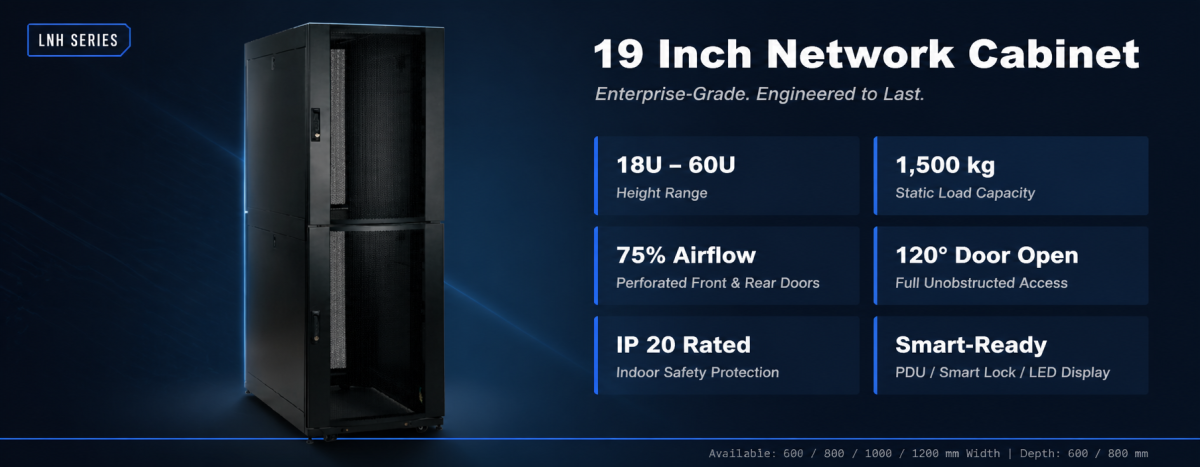
One of the most important attributes of any 19 inch network cabinet is its U-height — the number of rack units available for mounting equipment. The LNH Series offers an exceptionally wide range, from compact 18U configurations up to full-height 60U installations, making it suitable for deployments of virtually any scale.
Smaller U-heights (18U–24U) are ideal for branch offices, edge locations, and telecom distribution points where space is limited but equipment density must remain high. Mid-range configurations (27U–42U) suit the majority of enterprise server rooms and co-location deployments. Tall configurations (45U–60U) are designed for high-density data center rows where maximizing vertical space utilization is critical.
When selecting the correct U-height for your 19 inch network cabinet, always account for future growth. A common industry rule of thumb is to populate no more than 70–80% of a cabinet’s available rack units at initial deployment, leaving room for additional hardware, cable management accessories, and airflow blanking panels.
Width and Depth Configurations to Match Any Layout
The LNH Series 19 inch network cabinet is available in four width options — 600 mm, 800 mm, 1000 mm, and 1200 mm — and two depth options: 600 mm and 800 mm. This matrix of configurations allows network designers to select the precise footprint that fits their raised floor layout, aisle configuration, or wall-mount arrangement.
A 600 mm wide 19 inch network cabinet is the industry standard for most server and networking hardware. However, wider configurations (800 mm, 1000 mm, 1200 mm) provide critical additional space for side-mounted cable management channels, high-density patch panels with slack storage, and supplementary airflow equipment such as fan tray units.
Depth selection is equally important. Shallow-depth 19 inch network cabinet configurations (600 mm depth) work well for patch panels, switches, and light network equipment. For servers with long cable tails or high-density blade systems, the 800 mm depth option in the LNH Series provides the additional clearance required for clean rear cabling without forcing uncomfortable bends in power cables or fiber runs.
Structural Integrity: Why Frame Rigidity Defines a Quality 19 Inch Network Cabinet
Equipment failure caused by cabinet racking issues — loose rails, flexing frames, overtightened cage nuts stripping threads — is far more common than most IT teams realize. The LNH Series addresses this at the manufacturing level through a special plate-curving technique that dramatically increases frame rigidity compared to conventional welded or bolted frame construction.
The result is a 19 inch network cabinet rated for an extraordinary 1,500 kg loading capacity. This figure matters even in installations where total equipment weight falls well below that threshold, because frame rigidity translates directly to rail alignment accuracy. Misaligned rails cause mounting holes to bind, rack-mount equipment to sit at angles, and — in worst-case scenarios — brackets to crack under repeated vibration.
For installations subject to seismic activity, HVAC vibration, or high-traffic environments, a structurally rigid 19 inch network cabinet is not a luxury — it is a safety requirement. The LNH Series frame design ensures that even fully populated cabinets maintain precise rail alignment and structural integrity throughout their service life.
Heavy-Duty Mobility and Stability
Every LNH Series 19 inch network cabinet ships standard with heavy-duty castors for mobility during installation, combined with leveling feet for permanent stability once the unit is positioned. This combination is essential in live data center environments where cabinets must be moved to final position after being pre-populated with equipment, then locked in place precisely to align with raised floor tiles, cable trays, or containment aisle systems.
Ventilation and Airflow: The Thermal Science Behind a High-Performance 19 Inch Network Cabinet
Thermal management is the single most critical operational concern for any 19 inch network cabinet in a production environment. Servers, switches, and storage arrays generate significant heat loads, and even brief thermal excursions can trigger automatic throttling, unexpected shutdowns, and accelerated hardware aging.
The LNH Series engineers thermal performance into every surface of the enclosure. Both the front and rear doors feature perforated designs that guarantee 75% open airflow area. This specification is critical: many lower-cost 19 inch network cabinet products advertise ventilated doors but deliver only 40–55% open area, creating significant static pressure buildup inside the cabinet and forcing active cooling fans to work harder.
With 75% ventilation across both the front and rear doors, the LNH Series 19 inch network cabinet supports efficient front-to-rear airflow — the dominant thermal design pattern in modern server rooms and data centers. Cold air enters through the front door, passes through equipment, and exits hot through the rear door directly into hot-aisle containment systems or open room cooling circuits.
Cable entry is handled through large, sealed openings at both the top and bottom of the cabinet, covered with black cellular brush panels that block airflow bypass while still allowing cable passage. Optional brush cable entries can be added at any position on the cabinet body, giving cabling teams maximum flexibility without creating thermal bypass leaks that compromise carefully designed hot/cold aisle separation.
Security and Access Control in a Professional 19 Inch Network Cabinet
Physical security of network infrastructure is a non-negotiable requirement in regulated industries including finance, healthcare, government, and education. A professional 19 inch network cabinet must provide layered access control that prevents unauthorized interaction with live equipment while still enabling rapid legitimate access for authorized engineers.
The LNH Series delivers on both requirements. The curved perforated front door and the double-leaf flat perforated rear doors are each secured with swing handle locks, providing tamper-evident locking at both primary access points. The distinctive curved front door design is not merely aesthetic — the curvature reinforces door rigidity, preventing the flexing that can cause cheaper flat doors to warp over time and compromise their seals.
Side panels on the LNH Series 19 inch network cabinet feature a quick-release locking mechanism that allows authorized personnel to remove and reinstall panels rapidly without tools, while still providing firm resistance to casual access. Door hinges on both front and rear are engineered to swing open to 120 degrees, providing full, unobstructed access to the interior of the cabinet without requiring the door to be removed entirely.
An often-overlooked feature: all LNH Series doors are reversible — the door stop can be easily changed from left to right opening orientation without specialized tools. This flexibility is critical in row deployments where cabinet positioning relative to aisles and walls determines which opening direction is practical.
19 Inch Rail System: Precision Mounting for Every Equipment Type
The defining feature of any 19 inch network cabinet is, naturally, its 19-inch rail system. The LNH Series features precision-machined profile rails installed at both the front and rear of the cabinet interior, ensuring that equipment mounts flush, level, and securely regardless of the manufacturer or product generation.
A critical differentiator of the LNH Series is that its 19 inch profile rails are adjustable in depth. This feature — absent in many entry-level 19 inch network cabinet products — allows the rail position to be moved forward or backward within the cabinet to accommodate equipment of varying depths without requiring the use of extended brackets or rail adapters.
All LNH Series rails feature clear U-position markings, enabling rapid identification of available rack space during equipment deployment and troubleshooting. Each LNH Series 19 inch network cabinet ships with 25 sets of cage nuts pre-included, covering the majority of standard rack-mount equipment installations without requiring separate hardware purchases.
Cable Management: Keeping a 19 Inch Network Cabinet Organized at Scale
Unmanaged cabling is one of the primary causes of network downtime. In dense rack environments, a single incorrectly routed cable can block airflow across an entire server, mask a failing connector behind an impenetrable tangle of patch cords, or cause a chain reaction of disconnections during a routine equipment swap. Proper cable management within a 19 inch network cabinet is not optional — it is a fundamental operational discipline.
The LNH Series provides both horizontal and vertical cable management options to support any deployment architecture. The 800 mm wide configuration of the LNH Series 19 inch network cabinet ships with two vertical cable managers included as standard equipment — a significant value-add that eliminates the need for separate purchasing and installation steps. For narrower configurations or specialized cabling architectures, horizontal cable management channels are available as optional accessories.
Cable entry into the LNH Series 19 inch network cabinet is engineered for maximum flexibility. Large cellular brush-sealed openings at the top and bottom accommodate bulk cable runs from overhead trays or underfloor systems, while optional brush cable entries can be installed at any point on the cabinet body for localized cable routing needs. This design ensures that cabling teams can maintain clean, organized runs without compromising the thermal separation of the cabinet interior.
Smart Cabinet Integration: The Future-Ready 19 Inch Network Cabinet
The evolution of data center infrastructure management (DCIM) has transformed the 19 inch network cabinet from a passive enclosure into an active, intelligent node within the network. The LNH Series is designed from the ground up to support smart cabinet deployments, with provisions for integrating smart PDUs, intelligent locking systems, and front-door LED status displays.
A smart-enabled 19 inch network cabinet provides real-time visibility into power consumption at the individual outlet level, enabling IT operations teams to track energy usage, identify power anomalies before they cause failures, and accurately report on per-rack energy efficiency metrics. When combined with smart locking systems, the same cabinet can enforce granular access control policies, logging every cabinet access event with timestamps and user credentials.
The front-door LED screen capability available in the LNH Series 19 inch network cabinet takes operational awareness a step further, allowing status information, asset tags, or custom messages to be displayed directly on the cabinet exterior without requiring a separate monitoring terminal. For large data center floors with hundreds of cabinets, this capability dramatically speeds up visual identification and incident response.
As organizations move toward fully automated data centers and lights-out operation models, starting with a 19 inch network cabinet that supports smart integration at the hardware level — rather than requiring retrofits or after-market modifications — represents a significant long-term investment advantage.
IP Rating and Environmental Protection
The LNH Series 19 inch network cabinet carries an IP 20 safety rating, appropriate for standard indoor server room and data center deployments. IP 20 certification indicates protection against solid objects greater than 12.5 mm in diameter — including fingers and standard tools — making it suitable for any installation where human access control and tool-based servicing are the operational norm.
For deployments in environments with elevated dust levels, humidity, or physical access by non-technical personnel, the LNH Series can be complemented by higher-IP-rated accessories or deployed alongside the manufacturer’s outdoor and industrial enclosure product lines. Understanding the IP rating of your 19 inch network cabinet and matching it accurately to your deployment environment is a key step in ensuring long-term reliability.
Grounding integrity is included as a standard feature across the LNH Series — all cabinets ship with grounding wire pre-installed to ensure that every rack in a deployment maintains correct electrical safety bonding without additional field installation steps. Warning and safety stickers are affixed at both front and rear bottom frames, meeting international safety labeling standards for professional electrical enclosures.
Finish and Color Options for Professional Installations
The LNH Series 19 inch network cabinet is available in two industry-standard color finishes: RAL 7035 light grey and RAL 9005 black. Both finishes are applied using high-quality powder-coat processes that provide resistance to scratching, chipping, and corrosion in normal indoor operating environments.
RAL 7035 light grey is the traditional choice for telecommunications and networking installations, providing high visibility of cable labels, asset tags, and equipment indicator lights inside and around the cabinet. RAL 9005 black has become increasingly popular in modern data center aesthetics and in co-location facilities where visual uniformity across the cabinet row is a tenant requirement.
The choice of color for a 19 inch network cabinet may seem cosmetic, but in large-scale deployments it directly impacts operational efficiency. A consistent color scheme across all cabinets in a row or zone makes it easier to apply and read cabinet numbering systems, aisle signage, and equipment position labels — reducing the risk of human error during equipment swaps, patching, and troubleshooting activities.
Packaging and Logistics: Protecting Your 19 Inch Network Cabinet Investment
The LNH Series 19 inch network cabinet is available in two packaging configurations to match different logistics and installation scenarios. Flat-pack shipment reduces the volume and weight of each unit, lowering freight costs for large-quantity orders and making it practical to bring cabinets into buildings with restricted access routes — a common challenge in urban office building deployments.
For projects where pre-assembled delivery is preferred, the LNH Series is also available in assembly packing with pallet, allowing cabinets to arrive ready for immediate positioning and population without requiring assembly labor on site. Pre-assembled pallet delivery is the standard choice for data center fit-out projects where construction timelines are tight and on-site labor is at a premium.
Both packaging methods maintain the structural integrity of the 19 inch network cabinet through transit, protecting precision-machined rails, door hinges, and locking mechanisms from damage that could affect performance after installation. All packaging materials are clearly labeled with weight and handling requirements to ensure compliance with site safety protocols for heavy equipment delivery.
Key Factors to Evaluate When Selecting a 19 Inch Network Cabinet
With so many variables involved in choosing a 19 inch network cabinet, it helps to evaluate options against a structured checklist of the factors that most directly affect performance, reliability, and total cost of ownership.
- U-Height and Capacity Planning: Match current equipment inventory plus at least 30% headroom for growth. Avoid the temptation to save initial cost by selecting the smallest 19 inch network cabinetthat fits today’s needs — re-cabling and replacing cabinets mid-project is far more expensive than planning correctly upfront.
- Frame Rigidity and Load Rating: Confirm the static load rating of any 19 inch network cabinetunder consideration. For enterprise server deployments, a minimum 1,000 kg rating is advisable; the LNH Series 1,500 kg rating provides substantial additional margin.
- Airflow Percentage: Verify the actual percentage of open area in front and rear doors. Anything below 60% will create measurable thermal challenges in fully populated cabinets. The LNH Series guarantees 75% open area across both door surfaces.
- Rail Adjustability: Depth-adjustable rails make it possible to accommodate equipment from multiple generations without extra brackets. This feature is particularly valuable in mixed-vendor environments.
- Security Features: Consider whether your installation requires key-lock access only, or whether smart lock integration is needed for audit trail compliance. The LNH Series supports both.
- Cable Management Options: Assess whether your cabling architecture requires vertical management, horizontal management, or both. The LNH Series 800 mm 19 inch network cabinetincludes vertical managers as standard.
- Smart Integration Readiness: If DCIM deployment is planned within the next two to three years, select a 19 inch network cabinetthat supports smart PDU and smart lock integration from the start.
- Packaging and Delivery Format: Match packaging selection to your logistics chain and site access constraints. Flat-pack reduces freight costs; pallet assembly saves installation labor.
LNH Series Specifications at a Glance
For quick reference, here is a consolidated summary of the LNH Series 19 inch network cabinet specifications drawn from the official product data:
| Specification | LNH Series Detail |
| Height Range | 18U to 60U |
| Width Options | 600 mm / 800 mm / 1,000 mm / 1,200 mm |
| Depth Options | 600 mm / 800 mm |
| Load Capacity | 1,500 kg |
| IP Rating | IP 20 |
| Front Door | Curved perforated, swing handle lock, 120° opening |
| Rear Door | Double-leaf flat perforated, swing handle lock, 120° opening |
| Side Panels | Quick-release, lockable |
| Rail System | 19″ profile rails, front and rear, depth-adjustable, U-marked |
| Airflow | 75% open area on front and rear perforated doors |
| Cable Entry | Large top/bottom cellular brush entries; optional brush entries anywhere |
| Cable Management | 800 mm wide: 2× vertical cable managers included standard |
| Hardware Included | 25 sets cage nuts, heavy-duty castors, leveling feet, grounding wire |
| Smart Capability | Compatible with smart PDU, smart lock, front-door LED display |
| Color Options | RAL 7035 light grey / RAL 9005 black |
| Packaging | Flat-pack or pallet assembly |
Where Is a 19 Inch Network Cabinet Used? Common Deployment Scenarios
- Enterprise Data Centers: Large organizations consolidate compute and storage resources in centralized data halls. A high-density 19 inch network cabinetin the 42U–60U range, with smart PDU integration and full cable management infrastructure, forms the standard deployment unit.
- Co-location Facilities: Colo operators require 19 inch network cabinetsolutions that support tenant-level security (smart locks, access logging), high equipment density, and consistent thermal performance across mixed tenant hardware environments.
- Edge Computing Nodes: As workloads move closer to the network edge, smaller 19 inch network cabinetconfigurations (18U–27U) are deployed in remote locations, retail spaces, branch offices, and industrial facilities to host local compute resources that reduce latency for time-sensitive applications.
- Telecommunications Infrastructure: ISPs, mobile operators, and CLEC providers rely on the 19 inch network cabinetas the standard enclosure for aggregation switches, DSLAMs, fiber termination equipment, and OLTs in central offices and field distribution points.
- Healthcare and Government: Regulated industries require 19 inch network cabinetdeployments that meet strict physical security standards, provide full audit trails of equipment access, and integrate with facility security systems — all capabilities supported by the LNH Series smart cabinet ecosystem.
- Education and Research: Universities and research institutions managing distributed compute clusters, laboratory networks, and campus backbone infrastructure rely on reliable, scalable 19 inch network cabinetsolutions that can grow alongside expanding research programs.
Common Mistakes When Buying a 19 Inch Network Cabinet (and How to Avoid Them)
- Underestimating future capacity: Buying the smallest 19 inch network cabinetthat fits today’s equipment is one of the most expensive mistakes in IT infrastructure planning. Plan for at least 30% headroom.
- Ignoring airflow percentage: A 19 inch network cabinetwith 40% door perforation will create thermal problems in any moderately loaded installation. Always verify actual open area percentage, not just ‘ventilated’ labeling.
- Overlooking rail adjustability: Fixed-depth rails in a 19 inch network cabinetforce the use of additional brackets for equipment that does not match the fixed rail depth, adding cost and complicating cabling.
- Skipping cable management: Installing a 19 inch network cabinetwithout adequate vertical and horizontal cable management almost always leads to costly re-cabling projects within two to three years.
- Ignoring smart integration potential: Selecting a 19 inch network cabinetthat cannot support smart PDU or intelligent access control creates a costly retrofit problem when DCIM projects are initiated later.
- Choosing packaging without logistics analysis: Selecting pallet assembly packaging without verifying site access for large freight deliveries can create installation delays and additional handling costs.
Conclusion: Choosing the Right 19 Inch Network Cabinet Is a Strategic Decision
The 19 inch network cabinet you select today will define the operational efficiency, security posture, and scalability of your IT infrastructure for the next decade or more. It is not a commodity purchase — it is a strategic infrastructure investment that affects every device, application, and service that runs inside it.
The LNH Series delivers on every dimension that matters: a rigorous U-height range from 18U to 60U, width options from 600 mm to 1,200 mm, depth options of 600 mm and 800 mm, a 1,500 kg load rating, 75% airflow on front and rear doors, depth-adjustable 19-inch profile rails, smart cabinet integration capability, and professional-grade security features throughout. Whether your next deployment is a single-cabinet edge node or a hundred-cabinet data center row, the LNH Series 19 inch network cabinet provides the engineering foundation that modern IT infrastructure demands.
If you are evaluating 19 inch network cabinet options for an upcoming project, consider scheduling a technical consultation with the LNH Series team to discuss your specific U-height, depth, width, and smart integration requirements. Choosing the right cabinet now is the best investment you can make in your infrastructure’s long-term performance and reliability.