When organisations plan or expand a data center, server room, or network infrastructure deployment, one rack size consistently stands out as the ideal balance between capacity, flexibility, and cost-efficiency: the 45U cabinet. Sitting just above the industry-standard 42U form factor yet significantly more spacious than mid-range enclosures, the 45U cabinet offers IT teams the extra headroom they need to accommodate growing equipment inventories without committing to the full footprint of a custom or oversized rack.
This comprehensive guide explores every dimension of the 45U cabinet — from its core technical specifications and structural design principles to ventilation strategies, cable management best practices, and real-world application scenarios. Throughout, we draw on the engineering characteristics of the JAMANET LNH Series, a purpose-built heavy-duty server rack available in sizes from 18U through 60U that includes the 45U cabinet configuration, to illustrate how thoughtful product design translates into measurable operational benefits.
Whether you are specifying your first 45U cabinet for a growing small business, standardising a multi-rack deployment across a regional data center, or evaluating upgrade options for an existing infrastructure, this guide provides the factual foundation you need to make the right decision.
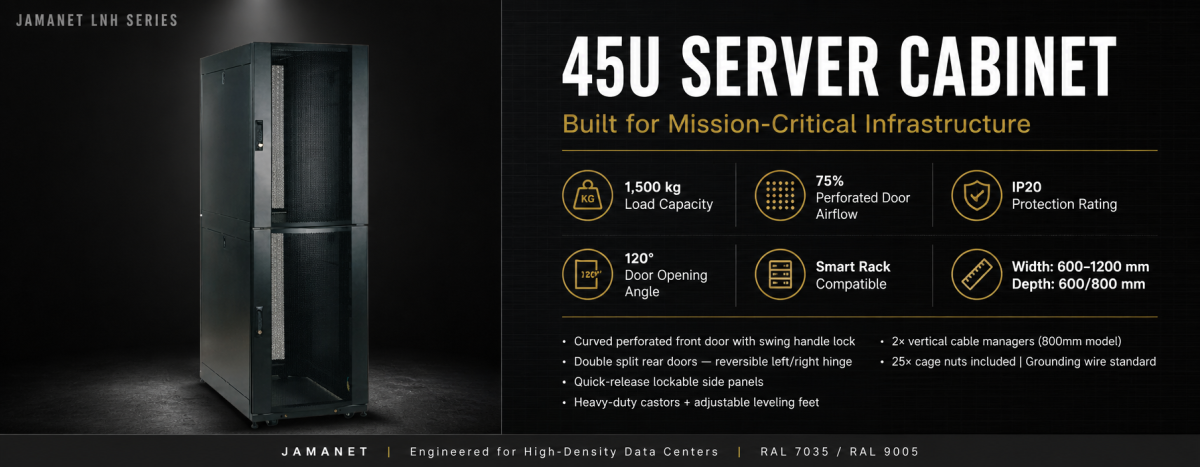
1. Understanding the 45U Cabinet: Size, Capacity, and Context
The term “45U” refers to the number of rack units (U) of vertical mounting space inside a rack enclosure. One rack unit equals 44.45 mm (1.75 inches) of vertical height, a dimension standardised by the Electronic Industries Alliance (EIA). A 45U cabinet therefore provides approximately 1,980 mm of usable mounting height — enough to house 45 individual 1U devices, or a mixed population of 1U, 2U, and 4U equipment that in practice fills the cabinet to a comfortable working density.
In the broader context of rack enclosure sizing, the 45U cabinet occupies a strategically important position. The 42U cabinet is by far the most widely deployed rack size globally, driven by standardised data center floor tile dimensions and the widespread availability of 42U-compatible accessories. However, the three additional rack units provided by a 45U cabinet create meaningful operational advantages that many IT managers overlook when initially specifying infrastructure.
Those three extra rack units in a 45U cabinet can accommodate an additional 1U patch panel, a power distribution unit (PDU), a keyboard-video-mouse (KVM) tray, or a dedicated cable management panel. In a densely populated rack where every unit of vertical space is valuable, this difference directly affects infrastructure organisation and operational efficiency.
The 45U cabinet is particularly well-suited to environments where equipment density is high, growth is anticipated, and the engineering team wants built-in flexibility without the cost and footprint implications of deploying a 47U or 48U enclosure. For many organisations, the 45U cabinet represents the optimal sweet spot between capacity and practicality.
2. Core Technical Specifications of a Professional 45U Cabinet
Not all 45U cabinets are engineered to the same standard. Understanding the key technical parameters that define enclosure quality helps buyers distinguish between products that will perform reliably for a decade and those that will create operational problems within months of deployment.
2.1 Width and Depth Dimensions
A 45U cabinet is available in multiple width and depth configurations to accommodate different equipment types and installation environments. The JAMANET LNH Series offers widths of 600 mm, 800 mm, 1000 mm, and 1200 mm, paired with depths of 600 mm and 800 mm.
Width selection for a 45U cabinet typically depends on whether additional cable management or side-mounted accessories are required. The standard 600 mm width accommodates all 19-inch rack equipment and most cable management accessories. The 800 mm width provides additional side space for vertical cable managers, tool storage, or wider airflow channels — making it the preferred choice for high-density deployments.
Depth is a critical dimension that is frequently underestimated when specifying a 45U cabinet. Modern enterprise networking equipment — managed switches, blade servers, high-density storage arrays, and GPU compute nodes — routinely has depths of 600 mm or more when cables are connected. A 45U cabinet with a depth of only 600 mm may physically accommodate these devices on the rail profile, but leaves no room for rear cable management or airflow separation. An 800 mm depth 45U cabinet is the recommended specification for any deployment involving full-depth enterprise hardware.
2.2 Load Capacity: The Engineering Foundation
Load capacity is perhaps the single most important structural specification of any 45U cabinet. A fully populated 45U cabinet in a modern data center can easily accumulate equipment weights of 800 kg or more when high-density blade servers, storage arrays, and dense switching hardware are installed across all 45 rack units.
The JAMANET LNH Series 45U cabinet is rated for a remarkable 1,500 kg load capacity — one of the highest ratings available in any commercially produced rack enclosure. This specification reflects the use of high-grade cold-rolled steel throughout the frame structure and a design approach that prioritises structural rigidity under extreme load conditions.
For IT managers specifying a 45U cabinet for a high-density deployment, understanding load capacity is not simply an academic exercise. A rack that fails structurally under load — even partially, through frame distortion or rail deflection — can damage installed equipment, disrupt network connectivity, and in the worst case create a serious safety hazard. Always verify that the 45U cabinet you specify carries a load rating that comfortably exceeds your maximum anticipated equipment weight.
2.3 Safety and Protection Rating
The JAMANET LNH Series 45U cabinet carries an IP20 protection rating, which is the appropriate classification for rack enclosures deployed in controlled indoor environments such as server rooms, data centers, network closets, and telecommunications facilities. IP20 provides protection against solid foreign objects larger than 12.5 mm, preventing accidental contact with internal components while maintaining the open airflow characteristics required for effective thermal management.
For the vast majority of 45U cabinet deployments in commercial, enterprise, and institutional environments, IP20 provides fully adequate protection. Applications requiring higher IP ratings — such as outdoor-adjacent installations or industrial environments with elevated dust or moisture — should be specified separately.
2.4 19-Inch Profile Rails: The Equipment Interface
The 19-inch equipment mounting standard is the universal interface that connects rack-mount hardware to the 45U cabinet structure. The JAMANET LNH Series includes precision-formed 19-inch profile rails mounted at both the front and rear of the cabinet interior, with depth adjustment capability that allows the mounting position to be optimised for different equipment configurations.
Each rail in the LNH Series 45U cabinet is clearly marked with U-position indicators, simplifying equipment layout planning and ensuring accurate rack unit spacing during installation. This detail matters particularly in dense deployments where equipment must be installed in a specific sequence and spacing errors can require complete reinstallation of affected devices.
The 800 mm wide LNH Series 45U cabinet includes two vertical cable managers as standard equipment — a feature that distinguishes it from many competing products that treat cable management as an aftercharge accessory.
3. Structural Design and Build Quality in a 45U Cabinet
The structural quality of a 45U cabinet is determined by a combination of material selection, frame geometry, and manufacturing precision. A 45U cabinet that flex under load, has poorly aligned doors, or uses thin-gauge steel in critical structural members will create ongoing operational problems — including difficulty opening doors, equipment misalignment, and in extreme cases, catastrophic frame failure.
3.1 Frame Rigidity and the Plate-Curving Technique
The JAMANET LNH Series 45U cabinet achieves exceptional frame rigidity through a special plate-curving manufacturing technique applied to the main structural members. This process creates frame sections with significantly higher stiffness-to-weight ratios than conventional flat or simple-bend steel profiles, allowing the 45U cabinet to achieve its 1,500 kg load rating without excessive material weight that would make the cabinet impractical to move or install.
Frame rigidity matters beyond simple load-bearing. A rigid 45U cabinet frame maintains precise alignment of the 19-inch profile rails under load, ensuring that rack-mount equipment slides in and out smoothly throughout the cabinet’s operational life. Frame distortion, even minor, can cause equipment to bind on the rails — creating installation difficulty and potential damage to equipment slide mechanisms.
3.2 Door Design and Access Security
The LNH Series 45U cabinet features a curved perforated front door with a swing handle lock, providing an elegant combination of visual access, passive airflow, and positive security. The curve of the front door adds structural stiffness to a panel that would otherwise be prone to flexing — a common quality problem in lower-grade rack enclosures.
The rear of the 45U cabinet is closed by double flat perforated split rear doors, also equipped with swing handle locks. The split-door design — where the rear is divided into two independently opening sections — is a significant operational convenience in dense data center environments where rear access space is limited. A technician can open one half of the rear door to access cable connections on one side of the rack without the full-width rear panel swinging into adjacent equipment or walkways.
Both front and rear doors of the LNH Series 45U cabinet open to 120 degrees, providing unobstructed access to the full depth of installed equipment for installation, cabling, and maintenance. The door stop mechanism can be repositioned from left-hand to right-hand opening without tools, accommodating different installation layouts and aisle configurations.
3.3 Side Panels and Security
The LNH Series 45U cabinet features quick-release lockable side panels that can be removed without tools for fast lateral access during installation or maintenance. This design accelerates the process of threading cables between adjacent racks, installing side-mounted accessories, or accessing equipment that requires lateral clearance.
3.4 Mobility and Positioning
Moving a fully or partially populated 45U cabinet is a practical challenge that the LNH Series addresses with heavy-duty castors that allow the rack to be rolled into position. Once positioned, level adjustable feet lock the 45U cabinet securely in place and take the load off the castors, preventing any movement that could stress cable connections or shift the rack’s alignment. This combination of mobility during installation and rigidity in operation is essential for any rack that may need to be repositioned during its operational life.
3.5 Colour and Finish Options
The LNH Series 45U cabinet is available in two industry-standard finishes: light grey (RAL 7035) and black (RAL 9005). RAL 7035 remains the traditional finish for telecommunications infrastructure and older data center environments. RAL 9005 is the preferred choice in modern data centers and enterprise server rooms where a consistent black aesthetic is maintained across all rack infrastructure.
4. Ventilation and Thermal Management in a 45U Cabinet
Thermal management is one of the most technically demanding aspects of deploying a 45U cabinet in a high-density environment. A fully populated 45U cabinet containing blade servers, high-density switching equipment, and power distribution hardware can generate heat loads exceeding 10–20 kW — enough to raise the internal temperature to damaging levels within minutes if airflow is inadequate.
4.1 Perforated Door Airflow: The First Line of Defence
The JAMANET LNH Series 45U cabinet achieves a 75% airflow rate through both front and rear perforated doors. This specification — derived from the ratio of open perforation area to total panel area — is one of the most important thermal performance metrics of any rack enclosure. A 75% airflow rate ensures that the pressure differential created by equipment cooling fans can draw sufficient cold air into the front of the 45U cabinet and exhaust hot air through the rear with minimal resistance.
In practice, this means that the LNH Series 45U cabinet does not create a significant thermal bottleneck even in high-density deployments where individual servers are operating at full cooling fan speed. The combination of perforated front and rear doors ensures that the cabinet itself does not impede the natural hot-aisle/cold-aisle airflow pattern that modern data centers rely on for efficient thermal management.
4.2 Cable Entry and Airflow Separation
The LNH Series 45U cabinet includes large cable entry openings at both the top and bottom of the enclosure, each covered by a black cellular cover plate that maintains a degree of airflow separation while allowing cables to pass through cleanly. Optional brush cable entries can be specified at any position on the cabinet for applications requiring a tighter seal around cable penetrations.
Maintaining airflow separation between cable bundles and equipment cooling channels is particularly important in a 45U cabinet because the sheer volume of cables required to connect 45 rack units of equipment can easily obstruct cooling airflow if cable management is not carefully planned and executed.
4.3 Best Practices for Thermal Management in a 45U Cabinet
IT teams deploying a 45U cabinet in a high-density environment should implement the following thermal management practices:
- Deploy the 45U cabinetin a hot-aisle/cold-aisle configuration, with cold air supplied from the front and hot air exhausted from the rear into a contained hot aisle
- Install blanking panels in all unused rack units to prevent hot air recirculation from rear to front within the cabinet
- Route power cables vertically using the included cable managers to keep horizontal airflow paths unobstructed
- Monitor internal cabinet temperature with a rack-mount temperature sensor and configure alerts for temperature thresholds
- Avoid installing very high heat-output equipment (such as GPU compute nodes) in the bottom rack units where cool air enters the cabinet — place these devices in the upper sections where airflow is highest
- Consider supplementary in-row or overhead cooling for deployments exceeding 8–10 kW of heat output per 45U cabinet
5. Cable Management in a 45U Cabinet
A fully populated 45U cabinet can easily contain hundreds of individual cable connections — network patch cables, fibre runs, power cords, USB management cables, and serial console connections. Without a disciplined approach to cable management, this volume of cabling creates a tangled mass that obstructs airflow, makes troubleshooting nearly impossible, and significantly increases the time required for any maintenance activity.
5.1 Vertical Cable Management
The JAMANET LNH Series 45U cabinet in the 800 mm wide configuration includes two vertical cable managers as standard equipment. These vertical cable managers — positioned on either side of the 19-inch equipment mounting area — provide a dedicated routing channel for cables that run vertically between patch panels, switches, and power distribution units. By separating vertical cable runs from the horizontal equipment mounting area, vertical cable managers preserve horizontal airflow channels and keep the overall cable structure organised.
5.2 Horizontal Cable Management
In addition to the included vertical managers, the LNH Series 45U cabinet supports optional horizontal and vertical cable management channels. Horizontal cable managers — typically 1U or 2U panels with cable rings or D-rings — are installed between equipment rows to capture and route the horizontal cable runs that connect patch panels to switches. A well-organised 45U cabinet typically includes a horizontal cable manager at every second or third rack unit to maintain cable organisation throughout the full height of the enclosure.
5.3 Cable Entry Points
The LNH Series 45U cabinet includes large cable entry openings at the top and bottom of the enclosure, with brush cable entry options available at any cabinet position. Proper use of these entry points — routing cables through designated openings rather than improvising entry routes through gaps in the door or side panel — is fundamental to maintaining the integrity of the cable management structure and the physical security of the cabinet.
5.4 Grounding and Electrical Safety
The LNH Series 45U cabinet includes grounding wire as standard equipment — an essential safety provision that is sometimes omitted from lower-quality rack enclosures. Proper grounding of the 45U cabinet frame protects equipment and personnel from electrical fault conditions and is a mandatory requirement in most professional data center and network infrastructure standards.
6. Smart Rack Integration: Future-Proofing Your 45U Cabinet
One of the most significant developments in rack infrastructure over the past decade is the emergence of the smart rack — a 45U cabinet or similar enclosure equipped with intelligent monitoring, access control, and power management systems that provide real-time visibility into the physical infrastructure layer.
The JAMANET LNH Series 45U cabinet is designed to support smart rack configurations, including compatibility with smart PDUs that monitor per-outlet power consumption and enable remote power cycling, smart locks that provide access logging and remote lock/unlock capability, and front door LED screens that display real-time status information for the equipment inside the cabinet.
For data center operators managing large numbers of 45U cabinets across multiple sites, the ability to remotely monitor power consumption, equipment status, and access events from a centralised management platform delivers significant operational efficiency gains. Smart rack functionality reduces the need for physical site visits for routine monitoring tasks and enables faster response to power anomalies or security incidents.
When specifying a 45U cabinet for a new deployment, considering smart rack compatibility upfront — even if full smart rack functionality is not implemented at initial deployment — avoids the need to replace or significantly modify the enclosure when smart infrastructure is added later.
7. Packaging and Logistics: Deploying the 45U Cabinet at Scale
For organisations deploying 45U cabinets across multiple sites or importing enclosures from international manufacturers, packaging and logistics efficiency directly affect total project cost and delivery timeline.
The JAMANET LNH Series 45U cabinet is available in two packaging configurations: flat-pack (knock-down) for maximum shipping efficiency, and assembled with pallet for deployments where on-site assembly time is the primary constraint. For large-scale multi-site deployments, flat-pack shipping typically delivers the better total cost of ownership, while assembled-with-pallet delivery is preferred for single-site installations where installation speed is the priority.
The LNH Series 45U cabinet ships complete with all hardware required for installation, including 25 sets of cage nuts as standard. This eliminates the need for separate hardware procurement and ensures that installation teams have all necessary components available on arrival.
8. Typical Applications: Where the 45U Cabinet Excels
The 45U cabinet format is well-suited to a wide range of deployment environments. Understanding the most common application scenarios helps IT managers match the cabinet specification to the specific requirements of each project.
8.1 Enterprise Data Centers
In enterprise data centers, the 45U cabinet provides the capacity to house a complete server cluster — including compute nodes, storage arrays, top-of-rack switching, and power distribution — within a single rack enclosure. The three additional rack units compared to a 42U enclosure provide dedicated space for a KVM tray, an additional patch panel, or a cable management panel that keeps the overall installation organised.
8.2 Colocation Facilities
Colocation data center operators frequently specify 45U cabinets as their standard customer rack because the additional capacity compared to 42U gives customers flexibility to grow their equipment footprint without immediately requiring additional cage or rack space. The 45U cabinet‘s compatibility with standard hot-aisle/cold-aisle cooling infrastructure and its 75% perforated door airflow rate make it an efficient fit for most colocation facility cooling designs.
8.3 Telecommunications Infrastructure
Telecommunications equipment — including DSLAM systems, optical distribution frames, media gateways, and carrier-grade switching platforms — often requires non-standard mounting heights that make the 45U cabinet‘s flexibility particularly valuable. The adjustable depth 19-inch profile rails and multiple width options of the LNH Series 45U cabinet accommodate the diverse physical form factors of telecommunications hardware.
8.4 Financial Services and High-Frequency Trading
Financial services organisations that operate high-frequency trading infrastructure, risk computation clusters, and real-time data processing systems require a 45U cabinet that can support extreme equipment densities with complete structural reliability. The LNH Series’s 1,500 kg load capacity and high-rigidity frame construction make it an appropriate choice for the most demanding financial services compute environments.
8.5 High-Performance Computing (HPC)
HPC clusters and AI training environments routinely deploy the highest equipment densities achievable within a standard rack footprint. A 45U cabinet in an HPC environment may house GPU compute nodes, high-bandwidth InfiniBand or Ethernet switching, and shared storage arrays — all generating significant heat loads that require the maximum passive airflow that a perforated-door 45U cabinet can provide.
9. How to Choose the Right 45U Cabinet: A Practical Evaluation Framework
Selecting the right 45U cabinet for a specific deployment requires a structured evaluation process. The following framework guides IT managers and procurement teams through the key decisions in logical sequence.
Step 1: Define Equipment Inventory and Growth Projections
Create a complete equipment list for the 45U cabinet, including all current and planned devices. Record the rack unit height, depth, and weight of each device. Sum total rack units, total depth requirements, and total equipment weight. Add a 25–30% growth buffer to all figures to determine minimum 45U cabinet specifications.
Step 2: Verify Width and Depth Requirements
Confirm that the 45U cabinet width and depth you select accommodate both the widest equipment (typically 19-inch standard) and the deepest equipment (check manufacturer specifications for each device, including connector protrusion). For most enterprise deployments, a 600 mm wide, 800 mm deep 45U cabinet is the recommended starting specification.
Step 3: Confirm Load Capacity with Safety Margin
Calculate total equipment weight and apply a minimum 1.5x safety factor when selecting 45U cabinet load rating. For a fully populated deployment with blade servers and storage arrays, verify that the 45U cabinet is rated well above the calculated load — the LNH Series’s 1,500 kg rating provides ample headroom for virtually any standard deployment.
Step 4: Evaluate Thermal Management Requirements
Estimate total cabinet heat output by summing the maximum power ratings of all installed equipment. For heat loads above 8 kW per 45U cabinet, plan for supplementary cooling beyond standard hot-aisle/cold-aisle airflow management. Verify that the selected 45U cabinet’s door perforation rate (75% for the LNH Series) is adequate for the planned equipment density.
Step 5: Plan Cable Management Infrastructure
Determine the cable management accessories required for the 45U cabinet deployment before ordering. For the 800 mm wide LNH Series 45U cabinet, two vertical cable managers are included as standard. Plan horizontal cable management panels at appropriate intervals and specify brush cable entries for any cable penetration points where dust control is important.
Step 6: Assess Smart Rack Requirements
Determine whether the 45U cabinet deployment requires smart rack capabilities such as remote power monitoring, per-outlet switching, access control logging, or environmental monitoring. If smart rack features are planned for future implementation, verify compatibility with the selected 45U cabinet model before purchase.
Step 7: Consider Packaging and Logistics
For multi-site deployments of 45U cabinets, evaluate flat-pack versus assembled packaging options. Calculate total freight cost for each packaging approach across the full deployment volume, and factor in on-site assembly time and labour cost for flat-pack options.
10. LNH Series 45U Cabinet: Key Specifications at a Glance
The following table summarises the key specifications of the JAMANET LNH Series relevant to the 45U cabinet configuration:
| Specification | LNH Series Detail |
| U Capacity Range | 18U – 60U (45U available) |
| Width Options | 600 mm / 800 mm / 1000 mm / 1200 mm |
| Depth Options | 600 mm / 800 mm |
| Load Capacity | 1,500 kg |
| Safety Rating | IP20 |
| Front Door | Curved perforated with swing handle lock |
| Rear Doors | Double flat perforated split, swing handle lock |
| Door Opening Angle | 120° (front and rear) |
| Door Hinge | Reversible left / right |
| 19″ Profile Rails | Front & rear, depth-adjustable, U-marked |
| Airflow Rate | 75% (front and rear perforated doors) |
| Vertical Cable Managers | 2 included (800 mm wide models) |
| Cable Entry | Top & bottom with cellular cover; brush entry optional |
| Side Panels | Quick-release lockable |
| Mobility | Heavy-duty castors + adjustable level feet |
| Hardware Included | 25 sets cage nuts |
| Grounding | Grounding wire included |
| Smart Rack Ready | Smart PDU / smart lock / LED screen compatible |
| Colour Options | RAL 7035 light grey / RAL 9005 black |
| Packaging | Flat-pack (KD) or assembled with pallet |
11. Common Mistakes to Avoid When Deploying a 45U Cabinet
Even experienced data center professionals make avoidable mistakes when deploying a 45U cabinet. The following errors are among the most common — and most costly — encountered in practice.
- Underestimating load requirements: Selecting a 45U cabinetbased on current equipment weight without accounting for future additions is the most common specification error. Always apply a generous growth margin to load calculations.
- Ignoring depth requirements: Specifying a 45U cabinetwith insufficient depth for full-depth enterprise equipment results in doors that cannot close and cable management that cannot be implemented properly.
- Neglecting blanking panels: Leaving unused rack units open in a 45U cabinetcreates hot air recirculation paths that reduce the effectiveness of the hot-aisle/cold-aisle cooling design and increase equipment operating temperatures.
- Poor cable management planning: Failing to plan cable routes before equipment installation in a 45U cabinetresults in a disorganised interior that restricts airflow and makes future maintenance significantly more time-consuming.
- Overlooking grounding: Failing to properly ground the 45U cabinetframe creates electrical safety risks and may violate applicable electrical codes and data center standards.
- Insufficient access space: Installing a 45U cabinetwithout adequate front and rear access space — ideally 1,000 mm or more per aisle — significantly reduces maintenance efficiency and may make door opening impossible.
Conclusion: Why the 45U Cabinet Deserves Its Place at the Heart of Modern IT Infrastructure
The 45U cabinet represents one of the most strategically sound investments available in IT infrastructure. Its combination of capacity, flexibility, and compatibility with standard data center design principles makes it the preferred rack enclosure choice for a wide range of enterprise, colocation, telecommunications, and high-performance computing deployments.
The JAMANET LNH Series delivers an exceptional 45U cabinet specification: 1,500 kg load capacity, 75% perforated door airflow, depth-adjustable 19-inch profile rails, reversible door hinges, included vertical cable managers, smart rack compatibility, and a full complement of installation hardware. Available in widths from 600 mm to 1200 mm and depths of 600 mm or 800 mm, the LNH Series 45U cabinet can be precisely configured for any professional deployment scenario.
Whether you are building a new data center from the ground up, expanding an existing infrastructure, or standardising a multi-site network deployment, investing in a high-quality 45U cabinet with the right specifications for your application delivers measurable returns in equipment uptime, maintenance efficiency, and total cost of ownership. The 45U cabinet is not simply a piece of metal — it is the physical foundation upon which reliable, scalable, and professionally managed IT infrastructure is built. Choose it with the same care and rigour you would apply to any other critical infrastructure decision.